 Skip to content

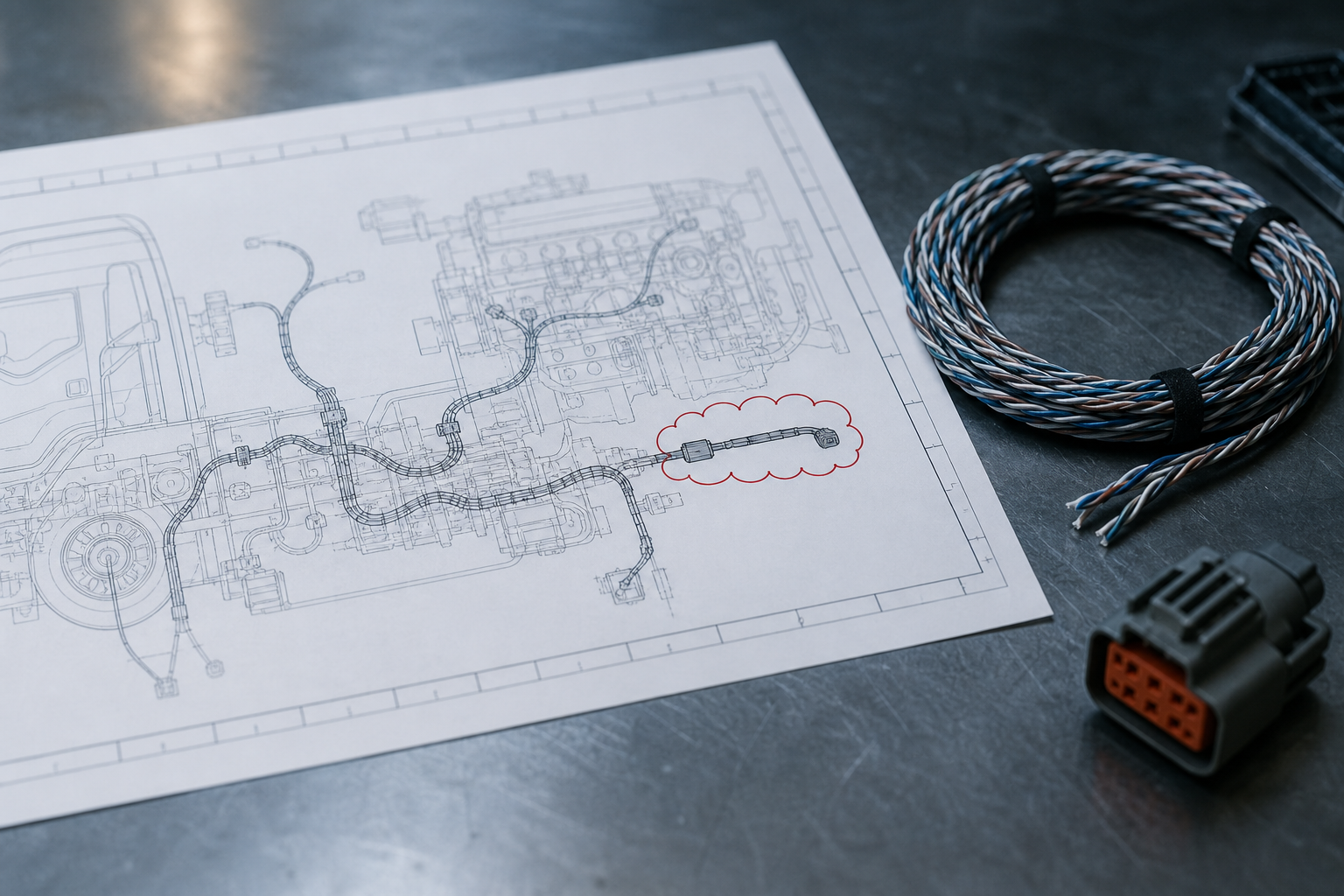
The change order that wrecks a harness program rarely arrives as a clear engineering note. It arrives as a sentence—“upgrade the J1939 CAN bus cable for EMI”—after drawings are frozen, cavities are tooled, and someone already promised a build date. That is when teams confuse a local electrical problem with a full backbone rewrite, and “one amendment” turns into respin hell.
"The change order landed after drawing freeze: 'upgrade the J1939 CAN bus cable for EMI.' Procurement read that as re-pulling the whole backbone. We didn’t. Cab and trailer spurs stayed on the released 125°C unshielded callout; only the engine-adjacent stubs moved to shielded J1939/11 at 150°C. One segment change, one 305 m sample lot to re-qualify—not a full harness respin. The vague PO would have cost us another 3–4 week loop for cable we never needed to touch."
— harness design lead, Class 8 chassis electrical, split-zone change after drawing freeze
I treat that story as a survival rule, not a war story. Mid-program cable changes stay alive when you shrink the amendment to the smallest interchangeable layer—zone, temperature class, shield type, AWG—then lock acceptance so the sample you approve is the lot you receive.
The Short Answer
Amend a released J1939 CAN bus cable spec by changing only the segments that fail the new constraint, rewriting the drawing in hard fields (standard, AWG, temperature, shield/drain), and re-qualifying one controlled sample lot—not by issuing a vague “better cable” PO for the entire backbone. If the change cannot be stated as interchangeable callouts, you are not amending a cable; you are launching a respin.
Why This Question Matters
Once a harness is released, every soft word in a change order becomes schedule risk. Fleet and vocational programs feel it as missed installs. Integrators feel it as a second PPAP-style loop they did not budget. Harness shops feel it as strip tooling, labels, and cavity fits that no longer match the BOM.
I have watched the same pattern across heavy-duty truck and equipment builds: EMI shows up near the engine, heat shows up on one stub, and the amendment language upgrades “the CAN cable” as if the vehicle had one homogeneous run. Cab, trailer, and chassis do not share the same abuse. Treating them as one SKU is how you burn another 3–4 weeks of lead time on cable you never needed to touch.
There is a second trap that belongs in every mid-program discussion. Marketplace “J1939 cable” often means a Deutsch diagnostic adapter for a scan tool—not SAE J1939 CAN bus network cable for the backbone. If a shortage forces a “drop-in,” confirm you are still amending network cable (twisted pair, 120 Ω class, J1939/11 or J1939/15), not swapping in a diagnostic lead that will never satisfy the harness drawing.
What follows is a field process for amending a released callout without dragging the whole program back to day one: map the failure to a zone, decide which fields are interchangeable, rewrite the change order so two suppliers cannot invent two parts, then lock sample-to-mass consistency before you scale.
Step 1: Map the Failure to a Zone—Not to “the Whole Bus”
Start with where the network actually misbehaves. Engine-adjacent stubs that see heat and EMI are not the same problem as a cabin spur that only needs clean routing. Trailer runs that live in low-EMI space rarely justify the same shield and temperature stack as a chassis segment beside alternators and solenoids.
When we walk a change order, I ask three location questions before any part number discussion:
Which connectors bound the failing segment?
Does the symptom appear only under load, PTO, or thermal soak?
Was the released cable already correct for that zone, or was the zone never called out separately?
If the answer is “only the engine stub fails soak,” your amendment target is that stub’s temperature and shield class—not a vehicle-wide upgrade. This is where CASPLAST-class choices stay practical: keep released J1939/15 or 125°C constructions on cab/trailer where they still meet the drawing, and move only the stressed segment to J1939/11 at 150°C when engine-bay duty demands it.
Common mistake: writing “upgrade all J1939 CAN bus cable to shielded” because one zone was noisy. Over-shielding the whole bus adds diameter, drain terminations, and new ways to ground-loop the harness. Precision beats panic.
If your next build slot is already booked, freezing the zone map now saves a second qualification loop later.
Related product:CASPLAST CAN-Bus 150
Step 2: Separate Interchangeable Fields from Respin Triggers
Not every field change forces a harness respin. Survival depends on knowing which amendments a released design can absorb.
| Field you want to change | Often interchangeable mid-program | Usually forces deeper respin |
|---|---|---|
| Temperature class on one zone (125°C → 150°C), same AWG/shield family | Yes, if connectors and strip process stay valid | If jacket OD or stiffness breaks clips/cavities |
| Shield: local J1939/15 → J1939/11 in high-EMI zones | Yes, with drain callout and single-point ground rules | If you “shield everything” and rewrite topology |
| AWG / mm² (0.5 ↔ 0.8) | Sometimes | Often—cavity, crimp, voltage drop, flex package |
| Impedance class / pair geometry intent (120 Ω class) | No—treat as structural | Yes—reflections and terminator math change |
| Product category (diagnostic adapter vs network cable) | Never “interchangeable” | Immediate wrong-part failure |
I keep this table taped next to change-control for a reason. Teams respin because they bundle a local temperature fix with an AWG change “while we are in there.” Mid-program discipline means one electrical intent per amendment whenever you can.
For Casmo’s published J1939 range, the practical interchangeable levers are standard (J1939/11 vs J1939/15), temperature (125°C vs 150°C on the /11 line), and conductor size (0.5 mm² / 20 AWG vs 0.8 mm² / 18 AWG)—used deliberately, not as a shopping list. See the J1939 CAN bus cable matrix before you freeze language.

Step 3: Rewrite the Change Order in Hard Callouts
Vague PO language is the root of dual-source chaos. “Better shielded J1939 cable ASAP” invites two constructions and one argument. Hard callouts invite one part family.
Minimum fields I want on a mid-program amendment for J1939 CAN bus cable:
- Standard: SAE J1939/11 (shielded twisted pair) or SAE J1939/15 (unshielded)
- Conductor size: 0.5 mm² or 0.8 mm² (state AWG if your BOM uses it)
- Temperature: e.g. −55°C / +125°C or −55°C / +150°C
- Impedance class: 120 Ω class per datasheet for the chosen SKU
- Shield/drain notes for /11: foil/braid intent and drain handling
- Zone applicability: “engine-adjacent stubs only” vs “full backbone”
- Sample rule: same insulation compound and process from sample lot to mass order
Compare soft vs hard wording:
| Soft change order (respin bait) | Hard change order (survivable) |
|---|---|
| Upgrade CAN cable for EMI | Engine-adjacent stubs: SAE J1939/11, 0.5 mm², −55/+150°C, 120 Ω class, Al/mylar + drain; cab/trailer remain released J1939/15 125°C |
| Use heavier wire if possible | No AWG change this CO; size locked at 0.5 mm² |
| Supplier may substitute equivalent | No category substitution; network cable only—no diagnostic/adapter leads |
If you are consolidating J1939/11 and J1939/15 in one supply base, say that in the amendment too. One facility and one datasheet process reduce the chance that “equivalent” means a silent jacket or compound change.
Step 4: Re-Qualify One Controlled Sample Lot—Then Stop Shopping
After the callout is hard, do not open a five-vendor bake-off unless the released supplier cannot meet the new fields. Mid-program, your enemy is time. Casmo’s standard commercial frame for these constructions is a 305 m minimum per variant and about 3–4 weeks from order confirmation—plan the sample inside that window instead of pretending lead time is zero.
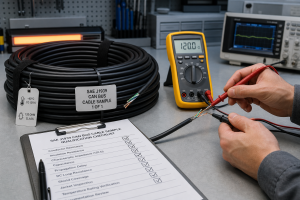
Acceptance I actually want on the sample coil before volume:
- Construction matches the amended callout (standard, size, temp, shield).
- Datasheet impedance class aligns with the SKU you named—do not blend ±5% marketing text with a ±10% card; cite the card you buy.
- Strip and terminate on your bench tools without inventing a new process.
- Compound/process continuity: the story you bought at sample is the story you get at mass (irradiation cross-linked constructions sold that way for a reason).
- Zone fit: the upgraded segment installs without forcing a clip or cavity redesign you did not approve.
If the sample fails strip or OD, that is a cavity/process problem—raise it now. Do not “approve electrically” and discover the harness shop cannot build at rate.
When sample approval is on the calendar, confirming temperature class and shield type against the zone map now prevents a second 305 m loop later.
Step 5: Issue the Amendment as a Zone ECO, Then Freeze Scope Creep
Close the loop in change control: updated drawing bubbles, BOM lines for the affected segments only, and a written ban on category substitution. Then freeze. The next well-meaning suggestion—“also bump AWG on the cab”—is how survival dies.
I also document what we explicitly did not change. Future auditors and second sources need to see that cab J1939/15 at 125°C remained intentional, not accidental. That note stops a later CO from “completing” an upgrade nobody asked for.
For teams that already published physical-layer literacy pieces on impedance and J1939/11 versus J1939/15, this step is the action layer those guides cannot finish: you are not re-arguing the standard—you are controlling which released lines move.
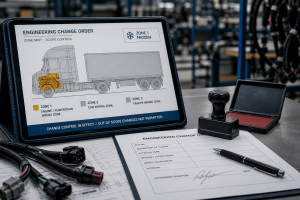
The Decision Framework
Use this when the change order hits your desk:
- If the fault is local heat or EMI on engine-adjacent stubs, amend those segments to J1939/11 and the required temperature class (150°C when soak demands it); leave compliant cab/trailer callouts alone.
- If the fault is wrong product category (diagnostic lead vs network cable), reject the substitution and amend language to SAE J1939 CAN bus network cable only—do not “fix” it with a random shielded SKU.
- If someone wants an AWG change plus shield plus temperature in one CO, split the requests; size changes are the usual respin trigger.
- If two suppliers cannot quote the same hard fields, your callout is still soft—rewrite before you buy.
- If sample compound or construction drifts from the approved coil, stop volume; a cheap mass lot that differs from sample is a delayed respin.
You are not choosing “the best cable on the internet.” You are choosing the smallest safe delta to a released harness.
Before You Decide
Before you release the amendment, confirm zone boundaries, cavity compatibility, drain grounding rules, and whether your MOQ/lead-time plan covers one honest sample lot. Datasheets will not tell you how your shop’s strip blades behave, or whether purchasing still has a diagnostic adapter on the approved-vendor list by mistake.
If you're sourcing at scale, talking to a supplier directly can surface details no product listing will tell you—especially same-compound sample-to-mass rules and whether 11 and 15 can ship from one process window.
Final Thought
Respin hell is usually a language failure that looks like a cable failure. The Insight from that Class 8 harness lead stays true: upgrade the segment that earns the upgrade, lock the callout so it can be inspected, and refuse to let a vague EMI sentence rewrite an entire backbone. Mid-program survival belongs to teams who amend with a scalpel—because a released J1939 network does not forgive a blunt change order.
Frequently Asked Questions
Can I change only part of a vehicle’s J1939 CAN bus cable after drawings are released?
Yes—if the amendment is written by zone. Engine-adjacent stubs can move to a higher temperature or to SAE J1939/11 while cab or trailer spurs keep a released J1939/15 or 125°C callout, provided connectors and routing still fit. The failure mode is issuing one vehicle-wide “upgrade all CAN cable” note when only one segment failed thermal or EMI stress.
What drawing fields should a mid-program J1939 cable change order include?
State the SAE layer (J1939/11 or J1939/15), conductor size (0.5 or 0.8 mm²), temperature rating, 120 Ω class per the chosen datasheet, shield/drain notes for shielded runs, and which harness zones the change applies to. Add an explicit ban on diagnostic-adapter substitutions. Soft phrases like “better shielded cable” are how two suppliers deliver two different parts.
Does moving from 125°C to 150°C always force a harness respin?
Not always. On many programs a temperature-class uplift on the same size and shield family is treatable as an interchangeable layer if jacket OD and strip process stay compatible. It becomes a respin when the new construction no longer fits clips, seals, or cavities—or when teams bundle an AWG change into the same amendment “for convenience.”
How do I avoid buying a diagnostic “J1939 cable” during a shortage?
Require SAE J1939 CAN bus network cable language on the PO: twisted-pair construction for J1939/11 or J1939/15, impedance class, and size. Refuse 9-pin scan-tool leads marketed only as “J1939 cable.” If the part cannot show a network-cable datasheet aligned to your callout, it is not a drop-in for the backbone.
What sample size and lead time should we plan when amending a Casmo J1939 callout?
Plan around a 305 m minimum per variant and a standard 3–4 week window from order confirmation unless your supplier confirms otherwise in writing. Use that lot for construction checks, strip trials, and zone fit before mass. Approving a scrap length and then ordering a different construction for volume recreates the respin you were trying to avoid.
When should we change AWG as part of a J1939 change order?
Only when electrical or mechanical analysis says the released size is wrong—voltage drop, flex life, or cavity intent. AWG swaps commonly force crimp and connector revalidation. If your real problem is EMI or heat, fix shield and temperature class first; do not “also” bump 0.5 mm² to 0.8 mm² without a separate decision.
Is shielding the entire backbone the safest mid-program EMI fix?
Often no. Shielded J1939/11 belongs in high-EMI zones with correct drain practice; unshielded J1939/15 can remain correct for low-EMI cabin or trailer runs. Blanket shielding increases diameter and termination errors and can create ground-loop behavior if shield rules are mishandled at the harness level. Map zones before you upgrade everything.
How do we keep a second source from drifting after the amendment?
Lock the same hard fields for every source, require datasheet alignment to the named SKU class, and tie approval to the sample lot’s construction and compound/process story. Dual-source without change-control fields is how “equivalent” becomes a silent jacket change. If a source cannot match the amended callout, it is not qualified for that ECO—period.
