Custom Engineering · 10 min read · Reviewed by CASMO Cable Engineering Team · Updated 2026-11-24
Direct Engineering Answer
UL 1007, UL 1015, and UL 1061 are the three most widely specified UL 758 PVC hook-up wires, separated by wall thickness, voltage class, thermal ceiling, and PVC hardness. Choose UL 1007 (80°C, 300V, 15-mil min. avg. flexible PVC wall) as the default internal hook-up wire for low-voltage electronics, control boards, and appliance harnesses where compact 2.0–4.2 mm pitch connectors cannot accept heavy walls. Choose UL 1015 (105°C, 600V, 30-mil min. avg. flexible PVC wall on 30–9 AWG) whenever circuits exceed 300V, ambient enclosure temperatures exceed 80°C, or heavier abrasion protection is required inside power supplies and industrial control cabinets. Choose UL 1061 (80°C, 300V, 9-mil min. avg. semi-rigid SR-PVC wall) for ultra-dense electronic bundles and Insulation Displacement Connectors (IDC) where minimum outer diameter and cut-through resistance matter more than supple hand flexibility.
At-a-Glance Specification Verdict — UL 1007 vs. UL 1015 vs. UL 1061
UL Style 1007 (Standard Wall)
80°C · 300V AC · 15 mil (0.38 mm) PVC · 32–16 AWG
- General internal appliance and electronic harnesses rated <= 300V and <= 80°C
- Compact board-to-board or crimp-housing connectors where 30-mil UL 1015 insulation will not seat
Limitation: Capped at 80°C / 300V; use UL 1569 (105°C / 300V / 15 mil) when you need 105°C without UL 1015 bulk
UL Style 1015 (Heavy Wall)
105°C · 600V AC · 30 mil (0.76 mm) PVC · 30 AWG–2000 kcmil
- Internal power wiring, switchgear, industrial cabinets, and motor leads needing 600V AC and 105°C ratings
- Rough panel routing where double wall thickness improves crush and scrape margin
Limitation: Nearly doubles insulation wall thickness vs. UL 1007, sharply increasing bundle O.D. and blocking fine-pitch housings
UL Style 1061 (Thin Wall SR-PVC)
80°C · 300V AC · 9 mil (0.23 mm) Semi-Rigid PVC · 30–14 AWG
- High-density backplanes, tight wire channels, and Insulation Displacement Connectors (IDC) requiring firm wall bite
- Minimizing wire bundle cross-section and mass without moving to higher-cost fluoropolymers
Limitation: Stiffer Semi-Rigid PVC bend feel than UL 1007 and limited to 80°C / 300V
Key Engineering Takeaways
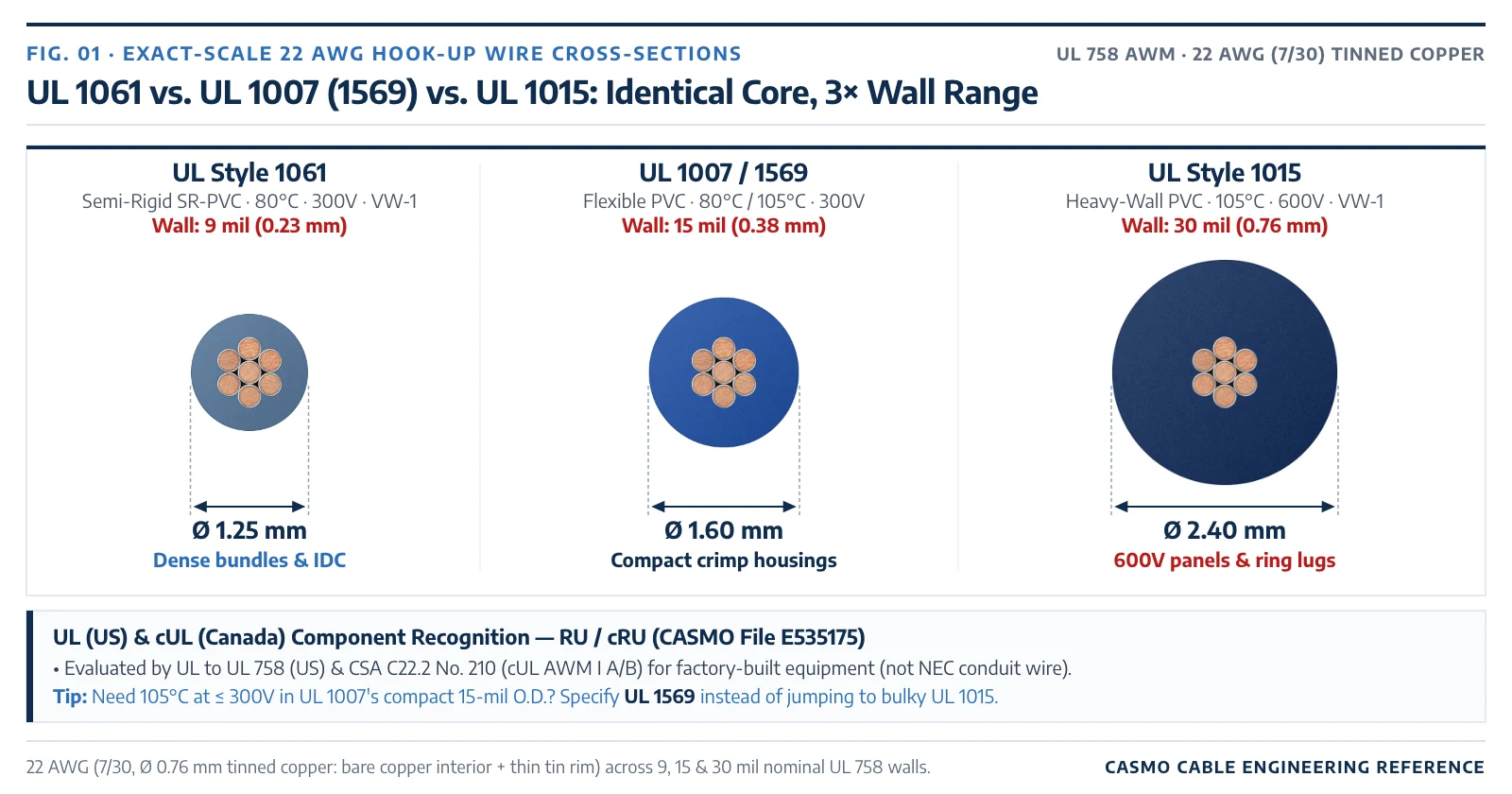
- Under UL 758 Style Pages, minimum average insulation wall thickness drives almost every mechanical difference: UL 1061 uses 9 mils (0.23 mm) SR-PVC, UL 1007 uses 15 mils (0.38 mm) PVC, and UL 1015 uses 30 mils (0.76 mm) PVC across 30–9 AWG (scaling up to 45–80 mils on heavier power gauges).
- All three styles pass UL 1581 VW-1 vertical flame testing and are eligible for dual US and Canadian Component Recognition — CASMO supplies UL and cUL Recognized AWM (RU / cRU, AWM I A/B under UL 758 and CSA C22.2 No. 210) under UL File E535175.
- Do not confuse cUL Recognized AWM (evaluated by UL to CSA C22.2 No. 210 for factory-built equipment) with separate CSA Group TEW/TR-64 markings or UL Listed building wire (UL 44 / UL 83 / MTW) required for standalone field conduit installation.
- When a 300V harness outgrows UL 1007's 80°C limit but cannot physically fit UL 1015's bulky 30-mil wall, UL 1569 (105°C, 300V, 15-mil PVC) or 125°C–150°C cross-linked XLPE (UL 3173 / UL 3266) solves the thermal gap cleanly.
Side-by-Side UL 758 Specification Matrix: UL 1007 vs. UL 1015 vs. UL 1061
Exact UL 758 wall thickness minimums, voltage classes, thermal ratings, and UL 1569 crossover option
Engineers designing North American appliances, power electronics, and industrial control panels routinely default to UL 1007 or UL 1015 out of habit without checking how insulation wall thickness alters connector crimp barrel retention, harness bundle diameter, and thermal margin. Adding UL 1061 (and the closely related 105°C crossover Style UL 1569) completes the core PVC hook-up design space under UL 758.
The table below summarizes the primary UL 758 Style Page parameters across all four constructions:
| Specification Parameter | UL Style 1061 | UL Style 1007 | UL Style 1569 (Crossover) | UL Style 1015 |
|---|---|---|---|---|
| Insulation Chemistry | Semi-Rigid PVC (SR-PVC) | Standard Flexible PVC | 105°C Heat-Stabilized PVC | 105°C Heat-Stabilized PVC |
| UL 758 Temperature Rating | 80°C | 80°C | 105°C | 105°C (80°C / 90°C options) |
| UL 758 Voltage Rating | 300 V AC | 300 V AC | 300 V AC | 600 V AC (750 V DC ref.) |
| UL Style Gauge Span | 30–14 AWG | 32–16 AWG | 30–16 AWG | 30 AWG–2000 kcmil (hook-up typically 30–8 AWG) |
| Min. Avg. Wall Thickness | 9 mils (0.23 mm) | 15 mils (0.38 mm) | 15 mils (0.38 mm) | 30 mils (0.76 mm) for 30–9 AWG; 45 mils (8–7 AWG); 60 mils (6–2 AWG); 80 mils (1–4/0 AWG) |
| Min. Wall at Any Point | 7 mils (0.18 mm) | 13 mils (0.33 mm) | 13 mils (0.33 mm) | 27 mils (0.69 mm) for 30–9 AWG |
| Approx. Nominal O.D. (22 AWG Stranded) | ~1.25–1.30 mm | ~1.60 mm | ~1.60 mm | ~2.35–2.45 mm |
| Vertical Flame Rating | UL VW-1 / cUL FT1 | UL VW-1 / cUL FT1 | UL VW-1 / cUL FT1 | UL VW-1 / cUL FT1 |
| Canadian cUL Designation (CASMO File E535175) | cUL AWM I A/B (CSA C22.2 No. 210) | cUL AWM I A/B (CSA C22.2 No. 210) | cUL AWM I A/B (CSA C22.2 No. 210) | cUL AWM I A/B (CSA C22.2 No. 210) |
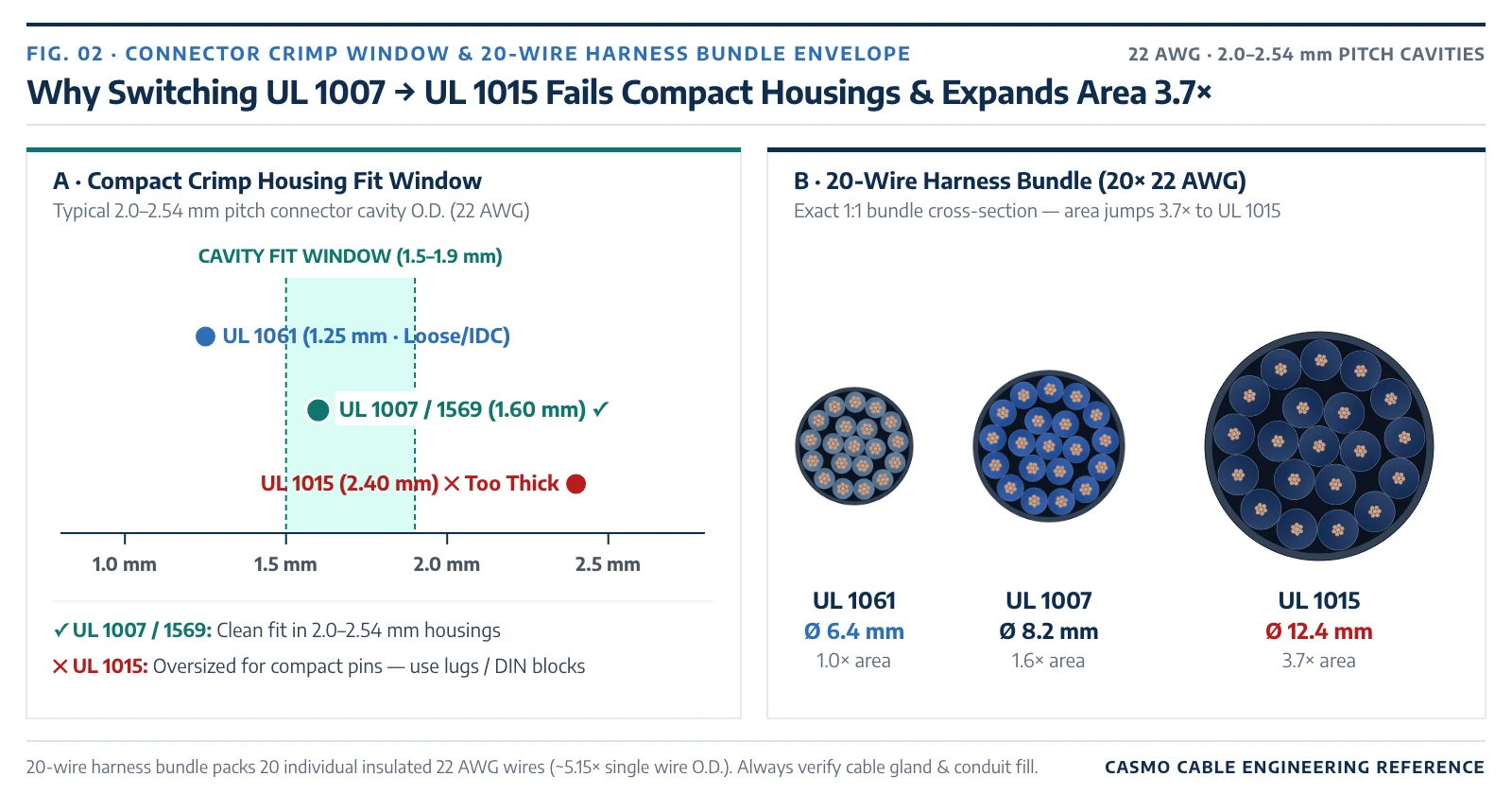
Notice the O.D. jump on 22 AWG stranded wire: stepping from UL 1061 (~1.25 mm) to UL 1007 (~1.60 mm) to UL 1015 (~2.40 mm) nearly quadruples the cross-sectional area of a 20-conductor harness bundle between UL 1061 and UL 1015.
Connector Crimp Windows, Bundle O.D., and Automated Processing
Preventing insulation-barrel rejections and seal failures before prototype build
The most common prototype failure when upgrading from UL 1007 to UL 1015 has nothing to do with electrical performance — it is mechanical interference at the connector housing. Popular 2.0 mm, 2.5 mm, and 2.54 mm pitch wire-to-board housings (such as compact crimp systems from Molex, JST, and TE Connectivity) typically enforce maximum insulation outer diameters between 1.5 mm and 1.9 mm on 22–20 AWG contacts. A 22 AWG UL 1007 lead (~1.60 mm O.D.) seats cleanly inside the insulation crimp wings and cavity seal, whereas a 22 AWG UL 1015 lead (~2.40 mm O.D.) physically refuses to enter the housing.
Conversely, plugging thin 9-mil UL 1061 wire (~1.25 mm O.D.) into a connector terminal sized for standard 15-mil UL 1007 insulation leaves the insulation crimp grip loose, allowing conductor strands to fatigue and fracture right behind the wire crimp under vibration. Always cross-check the connector manufacturer's published insulation-diameter acceptance range (min and max O.D.) against the exact wire gauge and UL style before releasing drawings.
- UL 1061 excels in Insulation Displacement Connectors (IDC) and tightly routed electronics because the 9-mil SR-PVC wall lets IDC tines slice cleanly through insulation while gripping firmly without cold-flow slip.
- UL 1007 hits the sweet spot for automated cut-strip-terminate crimp lines across 26–18 AWG appliance, HVAC control, and instrumentation harnesses.
- UL 1015 is built for screw-clamp terminal blocks, DIN-rail control cabinets, ring/spade lugs, power distribution assemblies, and 480V/600V machinery compartments where 30-mil wall clearance and thicker mechanical padding are expected.
Standard Plasticized PVC vs. Semi-Rigid PVC (SR-PVC)
How plasticizer content controls stiffness, cut-through resistance, and strip behavior
Both UL 1007 and UL 1015 use conventional plasticized flexible PVC compounds formulated to remain supple during manual harness routing and bundling. Raising plasticizer content lowers Shore A hardness and improves cold bend feel, but reduces mechanical cut-through strength — which is why UL 758 requires at least 15 mils average wall on UL 1007 and 30 mils on UL 1015.
UL 1061 cuts the minimum average wall down to 9 mils (0.23 mm) while maintaining a full 300V AC rating by switching to Semi-Rigid PVC (SR-PVC). Containing substantially lower plasticizer levels, SR-PVC exhibits higher Shore D hardness, superior scrape abrasion endurance, and stronger crush/cut-through resistance per millimeter of wall thickness. The trade-off is tactile stiffness: UL 1061 holds a bend set more noticeably than UL 1007 and is less forgiving in repeated flexing applications or sub-zero handling.
For automated wire stripping, SR-PVC breaks cleanly off the conductor with minimal stringing, whereas overly soft flexible PVC on heavy-wall UL 1015 requires properly matched V-blades or radius blades to avoid nicking fine tinned copper strands during long strip-length pulls.
UL Recognition (RU) vs. cUL Recognition (cRU under CSA C22.2 No. 210) vs. Listed Field Wire
Clarifying North American certification marks for OEM compliance audits
Agency marking confusion between UL, cUL, CSA, and Listed building wire causes frequent procurement delays in North American OEM programs. All UL 758 AWM styles — including UL 1007, UL 1015, UL 1061, and UL 1569 — are Component Recognized (RU) products rather than standalone UL Listed building cables. They are engineered and evaluated for factory-installed internal wiring or specified interconnection inside end-use equipment certified to an end-product standard (such as UL 508A industrial control panels, UL 62368-1 IT/AV equipment, or UL 60335 appliances).
For Canadian market acceptance, UL evaluates AWM wire directly against the Canadian standard CSA C22.2 No. 210 and grants cUL Component Recognition (cRU), marked on the wire and label as cUL AWM I A/B (Class I = internal wiring; Group A = electronic; Group B = appliance). CASMO holds both US UL Recognition and Canadian cUL Recognition under UL File E535175 (downloadable directly from our Quality & Compliance hub), verifiable online through UL Product iQ. Note clearly that CASMO holds UL and cUL recognition rather than standalone CSA Group certification marks (such as CSA TEW or CSA TR-64): for OEM equipment certified by UL or cUL, cUL AWM I A/B under CSA C22.2 No. 210 fulfills Canadian AWM component requirements, whereas specifications explicitly mandating standalone CSA Group mark or UL Listed field-conduit wire (such as UL 44 / UL 83 / MTW) require verifying end-product inspector acceptance before ordering.
When to Step Beyond PVC: UL 1569, Cross-Linked XLPE, and High-Temp Alternatives
Handling wave-solder heat, 125°C–200°C zones, and halogen-free requirements
Thermoplastic PVC softens and melts under localized soldering-iron contact, tight hot-clamp compression, or sustained temperatures above 105°C. Moreover, PVC contains chlorine, generating acidic halogen gas during combustion — disqualifying it from transit, marine, medical, or enclosed public-building assemblies requiring Low-Smoke Zero-Halogen (LSZH) materials.
When your application exceeds standard PVC boundaries, follow this clean engineering escalation path:
- Need 105°C at 300V in UL 1007's 15-mil compact footprint? Specify UL 1569 (often dual-marked UL 1007 / UL 1569 when built with 105°C PVC compound).
- Need solder-iron shrink-back immunity, 125°C–150°C thermal margin, or halogen-free compliance without fluoropolymer cost? Move to electron-beam cross-linked XLPE / XLPO hook-up styles such as UL 3173 (125°C / 600V), UL 3266 (125°C / 300V), or UL 3321 (150°C / 600V).
- Need 150°C–200°C ultra-flexible leads? Move to PFAS-free Silicone Rubber (UL 3132 / UL 3135) or melt-extruded FEP (UL 1330 / UL 1332) where chemical immunity and slim walls are paramount.
Frequently Asked Questions
- Can I substitute UL 1015 directly in place of UL 1007 on an existing BOM?
- Electrically and thermally yes — UL 1015 (600V / 105°C) exceeds UL 1007 (300V / 80°C) on every electrical rating. Mechanically, however, UL 1015 doubles minimum average wall thickness from 15 mils to 30 mils, which often prevents the wire from fitting into compact crimp connector cavities, cable glands, or tight routing clips sized for UL 1007.
- Why would an engineer pick UL 1569 instead of UL 1007 or UL 1015?
- UL 1569 bridges the exact gap between the two: it retains UL 1007's compact 15-mil wall thickness and 300V AC rating while upgrading the PVC compound to 105°C continuous operation — avoiding UL 1015's bulky 30-mil wall whenever 600V isolation is unnecessary.
- Is UL 1061 wire harder to bend than UL 1007?
- Yes. UL 1061 uses Semi-Rigid PVC (SR-PVC) with less plasticizer so its thin 9-mil wall resists cut-through and holds firmly inside Insulation Displacement Connectors (IDC). It routes cleanly in dense static backplanes, whereas UL 1007 feels noticeably softer for tight hand-formed harnesses.
- Does CASMO's UL File E535175 cover both US and Canadian compliance for UL 1007, UL 1015, and UL 1061?
- Yes for UL and cUL Component Recognition. CASMO holds US UL Recognition (RU under UL 758) and Canadian cUL Recognition (cRU, AWM I A/B evaluated by UL to CSA C22.2 No. 210) under UL File E535175. CASMO does not carry separate CSA Group TEW or TR-64 marks; confirm with your compliance engineer whether cUL AWM I A/B satisfies your Canadian equipment listing.
- Can UL 1015 hook-up wire be used as standalone building conduit wire under the NEC?
- Not as a standalone UL 758 AWM component. UL 758 AWM styles are Component Recognized (RU / cRU) for factory-built appliances, machinery, and control panels. Standalone field installation inside building raceways under the National Electrical Code requires UL Listed building or machine-tool wires (such as UL 44 XHHW-2/SIS or UL 83 THHN/MTW).
- What is the best upgrade if PVC insulation melts back during wave or hand soldering?
- Switch to electron-beam cross-linked XLPE hook-up wire (such as UL 3266 at 300V / 125°C or UL 3173 at 600V / 125°C). Cross-linking creates a permanent thermoset polymer network that refuses to melt or pull back from solder joints.
Regulatory & Engineering References
- UL Standards — UL 758 Standard for Appliance Wiring Material (AWM): Style Pages 1007, 1015, 1061, and 1569.
- CSA Group / UL Harmonized Evaluation — CSA C22.2 No. 210 (Appliance Wiring Material Products) governing cUL AWM Class I Group A/B component recognition.
- UL Standards — UL 1581 Reference Standard for Electrical Wires, Cables, and Flexible Cords (VW-1 vertical flame test, spark testing, and wall thickness measurement).
- UL Standards — UL 508A Standard for Industrial Control Panels (internal panel wiring recognition vs. field wiring boundaries).
- CASMO CABLE LLC — UL & cUL Component Recognition Certificates (UL File E535175, US and Canada).