High-Temperature Materials · 11 min read · Reviewed by CASMO Cable Engineering Team · Updated 2026-11-24
Direct Engineering Answer
PTFE, FEP, and PFA are all fully fluorinated perfluoropolymers sharing an ultra-low dielectric constant near 2.1 and near-universal chemical immunity, but they diverge sharply in extrusion physics, continuous reel length, thermal ceiling, and resin cost. Choose paste-extruded PTFE (ASTM D4895, up to 260°C) for thin-wall single-conductor hook-up wires (NEMA HP 3, UL 1180, UL 1213) and RF coax where the lowest dissipation factor (around 0.0002 at 1 MHz) and highest melting point (327°C) justify finite splice-free preform lengths. Choose melt-extruded FEP (ASTM D2116, up to 200°C) when continuous operating temperatures stay at or below 200°C and you need long splice-free spools, smooth thin walls, or multi-core outer jackets (NEMA HP 4, UL 1330, UL 1332) at lower cost. Choose melt-extruded PFA (ASTM D3307, up to 250°C–260°C) when your design demands both PTFE-class continuous heat (UL 1726, UL 1727, UL 10362) and continuous void-free melt extrusion or superior high-temperature flex and stress-crack endurance.
At-a-Glance Specification Verdict — PTFE vs. FEP vs. PFA
PTFE (Polytetrafluoroethylene)
Up to 260°C · 327°C Melt · Paste-Extruded & Sintered · εr ~2.1
- Ultra-thin 6–15 mil hook-up walls (NEMA HP 3, AS 22759/9–/12, UL 1180) or minimum RF loss tangent (~0.0002 at 1 MHz)
- Continuous 200°C–260°C thermal ceiling paired with silver- or nickel-plated copper and harsh chemical exposure
Limitation: Non-melt paste extrusion caps continuous splice-free lengths and practical extruded outer diameter (~6.5 mm)
FEP (Fluorinated Ethylene Propylene)
Up to 200°C · 255°C–275°C Melt · Melt-Extruded · εr ~2.1
- Continuous operating temperature stays <= 200°C (UL 1330, UL 1332, NEMA HP 4) and long splice-free reels are required
- Multi-core chemical, thermocouple, or plenum outer jackets where PTFE paste extrusion is impractical
Limitation: 60°C lower continuous thermal ceiling than PTFE/PFA and lower flex-fatigue endurance at elevated temperatures
PFA (Perfluoroalkoxy)
250°C–260°C · 305°C–310°C Melt · Melt-Extruded · εr ~2.1
- Applications need PTFE-class 250°C–260°C endurance (UL 1726, UL 1727, UL 10362) plus continuous pinhole-free melt extrusion
- High-purity semiconductor, downhole sensor, or multi-core 250°C jackets demanding superior stress-crack resistance
Limitation: Highest raw resin cost among melt-processable fluoropolymers; verify 250°C vs. 260°C conductor plating limits
Key Engineering Takeaways
- All three perfluoropolymers share a carbon-fluorine backbone delivering a dielectric constant near 2.1, inherent UL VW-1 vertical flame resistance, and near-total immunity to fuels, oils, acids, and industrial solvents.
- Manufacturing physics separates PTFE from FEP and PFA: PTFE (ASTM D4895) cannot melt-flow and must be ram/paste extruded in finite preform batches then thermally sintered, whereas FEP (ASTM D2116) and PFA (ASTM D3307) run on continuous melt extruders for long, void-free reels and heavy multi-core jackets.
- Insulation chemistry alone never sets a wire's temperature rating — silver-plated copper (ASTM B298) caps continuous service at 200°C even under PTFE or PFA, while nickel-plated copper (ASTM B355) is required to unlock 250°C–260°C service.
- Under UL 758 AWM, FEP is commonly recognized at 200°C (UL 1330 600V 20-mil wall; UL 1332 300V 13-mil wall), PFA steps up to 250°C (UL 1726 300V 13-mil; UL 1727 600V 20-mil; UL 10362 600V 10-mil thin wall), and PTFE spans UL 1180 (200°C/300V) alongside NEMA HP 3 and SAE AS22759.
Side-by-Side Engineering Matrix: PTFE vs. FEP vs. PFA
ASTM resin specifications, thermal ceilings, electrical loss, and processing constraints compared directly
Because PTFE, FEP, and PFA are all perfluorinated polymers, datasheets frequently group them under a generic fluoropolymer label. In wire extrusion and high-reliability harness assembly, however, their melt rheology, continuous thermal limits, dissipation factors, and cost structures create clear engineering boundaries.
The reference table below consolidates resin properties grounded in ASTM D4895 (PTFE fine powder paste-extrusion resins), ASTM D2116 (FEP extrusion resins), and ASTM D3307 (PFA extrusion resins) alongside common UL 758 AWM and NEMA HP cable families:
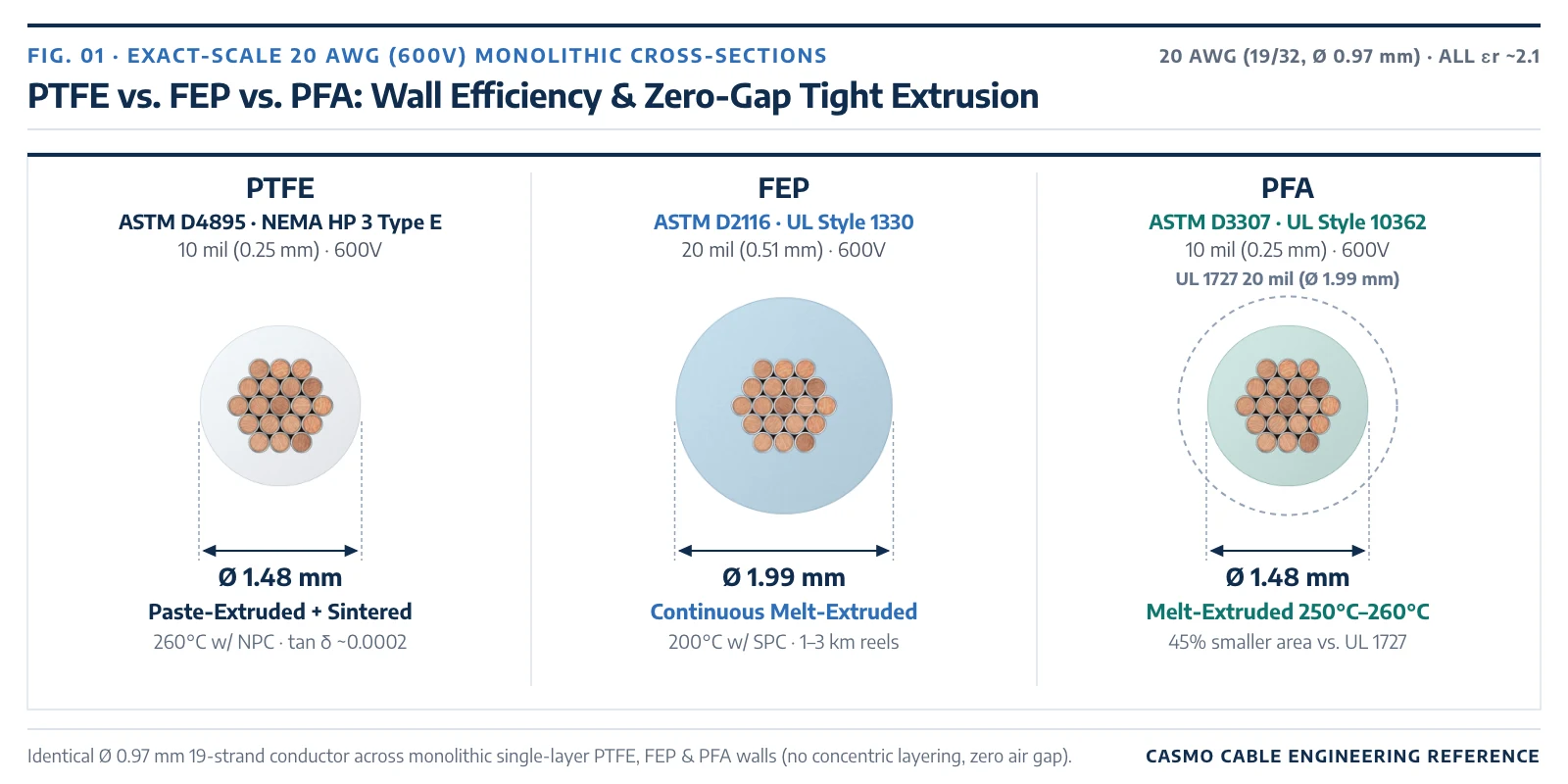
| Property / Criterion | PTFE (ASTM D4895) | FEP (ASTM D2116) | PFA (ASTM D3307) |
|---|---|---|---|
| CAS Registry Number | 9002-84-0 | 25067-11-2 | 26655-00-5 |
| Crystalline Melting Point | 327°C (620°F) | 255°C–275°C (491°F–527°F) | 305°C–310°C (581°F–590°F) |
| Continuous Service Ceiling | Up to 260°C (200°C w/ SPC; 260°C w/ NPC) | Up to 200°C | 250°C (UL 758 AWM) to 260°C (special/sensor) |
| Extrusion Mechanism | Non-melt paste extrusion + high-temp sintering oven (or wrapped tape) | Continuous thermoplastic melt extrusion | Continuous thermoplastic melt extrusion |
| Dielectric Constant (εr, 1 kHz–1 MHz) | ~2.1 (virtually flat vs. frequency) | ~2.1 | ~2.1 |
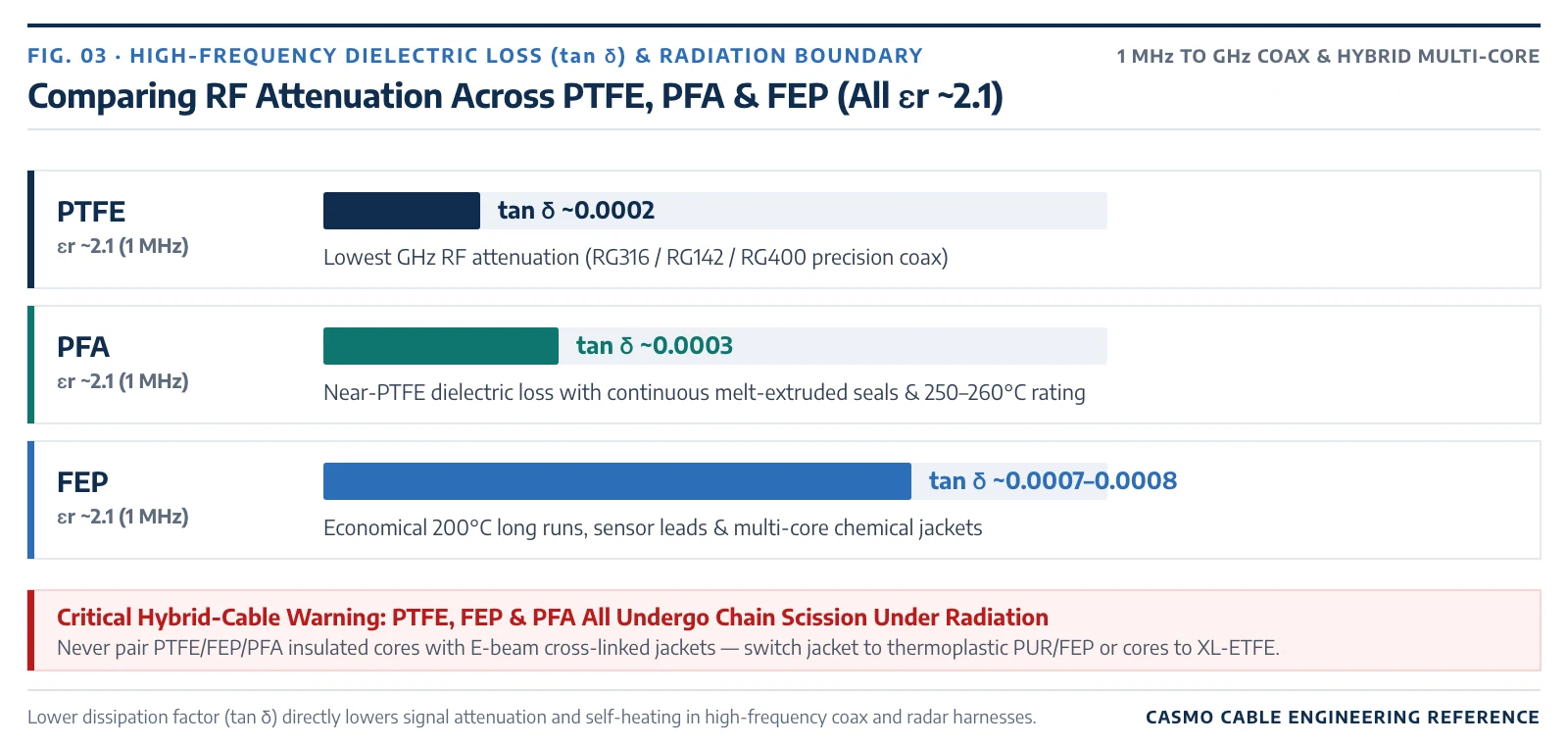
| Dissipation Factor (tan δ at 1 MHz) | ~0.0002 (lowest RF attenuation) | ~0.0007–0.0008 | ~0.0003 |
| Continuous Splice-Free Length | Bounded by paste preform billet size | Long continuous reels (melt-fed) | Long continuous reels (melt-fed) |
| Multi-Core Outer Jacketing | Limited (<= ~6.5 mm extruded O.D.; wrapped tape used for larger cores) | Excellent (smooth, pinhole-free jackets) | Excellent (high-temp 250°C–260°C jackets) |
| Key UL 758 & NEMA Standards | NEMA HP 3 (ET/E/EE), AS22759/9–/12, UL 1180, UL 1213 | NEMA HP 4 (KT/K/KK), UL 1330, UL 1332 | UL 1726, UL 1727, UL 10362, high-temp thermocouple & sensor cables |
| Relative Raw Resin Cost | Baseline fluoropolymer | Moderate (often lower total wire cost on long runs) | Highest resin cost (premium melt-processable 260°C) |
Paste Extrusion & Sintering vs. Melt Extrusion: Why Manufacturing Physics Matters
How preform batch limits, concentricity, and pinhole integrity shape wire sourcing
Polytetrafluoroethylene (PTFE) exhibits an extraordinarily high melt viscosity — roughly six orders of magnitude higher than standard thermoplastics — even above its 327°C melting transition. It does not flow through a conventional screw extruder. Instead, wire manufacturers blend ASTM D4895 fine PTFE powder with an aliphatic hydrocarbon extrusion aid, compress the paste into cylindrical billets (preforms), ram-extrude the paste over the conductor, evaporate the lubricant, and sinter the wall in a multi-zone oven above 360°C.
That paste-and-sinter process produces remarkably thin, concentric, chemically pure walls (down to 6 mils on NEMA HP 3 Type ET) with unmatched thermal shock immunity during hand soldering. However, every preform billet holds a finite volume of resin. On heavier gauges or thicker walls, continuous splice-free reel lengths are physically constrained by billet capacity, and practical extruded PTFE finished outer diameter generally tops out near 6.5 mm. Above that diameter, manufacturers switch to helically wrapped and sintered PTFE tape, which introduces lap seams.
FEP (a copolymer of tetrafluoroethylene and hexafluoropropylene) and PFA (a copolymer of tetrafluoroethylene and perfluoroalkyl vinyl ether) modify the PTFE molecular chain just enough to enable true thermoplastic melt flow. Both extrude continuously through corrosion-resistant high-nickel-alloy screw barrels, yielding seamless, pinhole-free walls over multi-kilometer reels and smooth outer jackets over shielded twisted pairs, instrumentation bundles, and thermocouple assemblies.
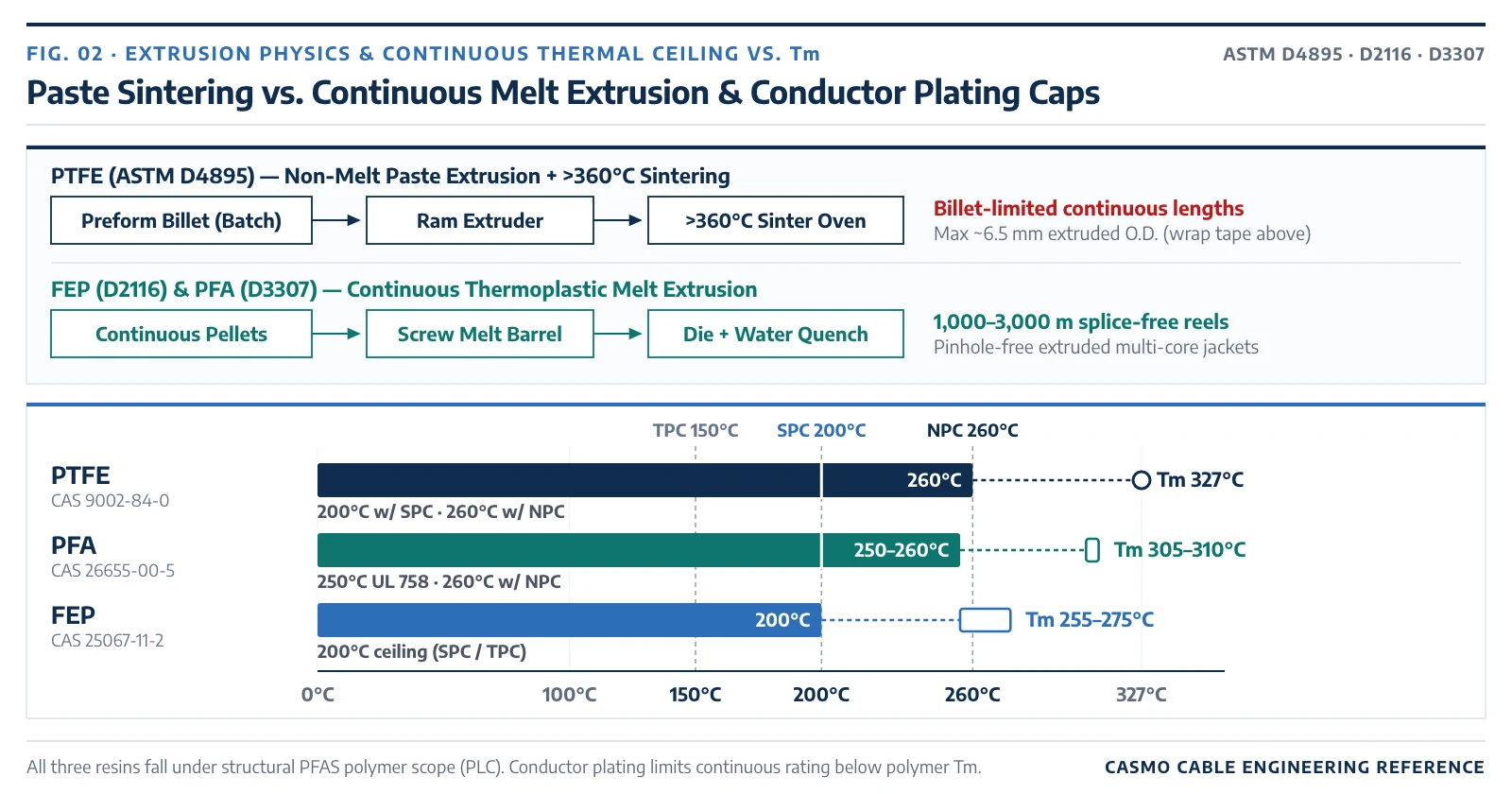
- When automated harness cut-strip machines demand long, uninterrupted 1,000 m to 3,000 m reels without spark-test splices, melt-extruded FEP (up to 200°C) or PFA (up to 250°C–260°C) consistently reduces machine changeover waste versus paste-extruded PTFE.
- Because FEP and PFA solidify from a continuous homogeneous melt rather than sintered powder particles, they offer lower gas and moisture vapor permeability in thin walls — critical in chemical-immersion level probes and wet semiconductor scrubbers.
- Where tight-radius micro-coax or 260°C aerospace hook-up wires require ultra-thin walls and minimal dielectric loss tangent (~0.0002), sintered PTFE remains the electrical benchmark.
UL 758 AWM Styles, Wall Thicknesses & Conductor Plating Boundaries
Why conductor metallurgy (tin, silver, nickel) must match the fluoropolymer thermal tier
A frequent specification error on OEM drawings is pairing a 250°C PFA or 260°C PTFE insulation callout with tin-plated or silver-plated copper while expecting full 250°C–260°C service life. At elevated temperatures, copper oxidizes rapidly and intermetallic diffusion degrades contact resistance. Standard industry practice aligned with ASTM B33, ASTM B298, and ASTM B355 ties continuous temperature ceilings directly to conductor plating: tin-plated copper is generally bounded to 150°C (with specific UL styles permitting 200°C only when qualified under style-specific aging rules), silver-plated copper (ASTM B298) serves up to 200°C, and nickel-plated copper (ASTM B355) is required for continuous 250°C–260°C duty.
Under UL 758 Appliance Wiring Material (AWM), CASMO manufactures UL and cUL Recognized fluoropolymer styles under File E535175 spanning PTFE, FEP, and PFA constructions. Notice how voltage rating and wall thickness vary sharply even within the same polymer family:
| UL 758 Style | Fluoropolymer | UL Temp / Voltage Rating | Min. Avg. Wall (Fine Gauges) | Primary Engineering Use Case |
|---|---|---|---|---|
| UL 1180 | Extruded PTFE | 200°C / 300 V AC | 13 mils (~0.33 mm) | High-temp internal electronic & appliance hook-up wire |
| UL 1213 | Extruded PTFE | 105°C / Voltage Not Specified (thin wall) | 8–10 mils (~0.20–0.25 mm) | Compact internal leads often dual-built to NEMA HP 3 Type E dimensions |
| UL 1332 | Melt-Extruded FEP | 200°C / 300 V AC | 13 mils (~0.33 mm) on 30–10 AWG | Compact 200°C equipment wiring, sensor harnesses, long continuous spools |
| UL 1330 | Melt-Extruded FEP | 200°C / 600 V AC | 20 mils (~0.51 mm) on 30–10 AWG | 600V high-temp appliance, lighting, motor lead, and industrial wiring |
| UL 1726 | Melt-Extruded PFA | 250°C / 300 V AC | 13 mils (~0.33 mm) on 32–10 AWG | 250°C continuous internal equipment wiring with melt-extruded consistency |
| UL 1727 | Melt-Extruded PFA | 250°C / 600 V AC | 20 mils (~0.51 mm) on 32–10 AWG | Heavy-wall 600V / 250°C power, heating-zone, and chemical-duty leads |
| UL 10362 | Melt-Extruded PFA | 250°C / 600 V AC | 10 mils (~0.25 mm) on 30–10 AWG | Space- and weight-saving thin-wall 600V / 250°C PFA hook-up wire |
Engineering tip: If your design currently specifies thick 20-mil UL 1727 PFA purely to obtain 600V / 250°C recognition in a tight harness, UL 10362 delivers the same 600V / 250°C rating at half the minimum average wall thickness (10 mils on 30–10 AWG), substantially cutting both resin cost and finished bundle diameter.
Mechanical Endurance, Creep, and Multi-Core Jacket Pitfalls
Where PFA beats FEP in flex fatigue — and why irradiated jackets destroy all three
At room temperature, FEP and PFA appear visually and mechanically similar, yet their long-term mechanical endurance diverges significantly above 150°C. PFA's alkoxy side groups provide greater polymer chain entanglement and higher crystallinity stability than FEP, translating into markedly higher MIT folding endurance, stronger retention of tensile modulus near 200°C, and superior environmental stress-crack resistance (ESCR) in hot corrosive vapors and steam.
PTFE, while thermally unmatched up to 260°C, is susceptible to cold-flow creep under sustained localized point loads such as sharp metal P-clamps or over-tightened cable ties. In harsh mechanical zones where abrasion or pinch resistance matters more than 260°C thermal margin, engineers often transition to partially fluorinated ETFE or cross-linked XL-ETFE (150°C–200°C) or PFAS-free PEEK (260°C).
One critical assembly trap applies identically to PTFE, FEP, and PFA: none of these perfluoropolymers tolerate ionizing radiation. Attempting to apply an electron-beam cross-linked PUR, XLPO, or irradiated elastomer outer jacket over PTFE, FEP, or PFA insulated cores induces rapid C–C backbone chain scission inside the fluoropolymer primary insulation, causing brittle fracture during bending. Always pair fluoropolymer primary cores with non-irradiated thermoplastic jackets (FEP, PFA, non-irradiated TPU/PUR, or thermally cured silicone).
Cost Optimization & 2026–2027 PFAS BOM Strategy
Matching resin selection to real thermal envelopes and regulatory disclosure requirements
From a total landed cost perspective, FEP is typically the most economical fluoropolymer for 200°C multi-core cables and long-run 300V/600V hook-up wires, because high-speed continuous melt extrusion offsets resin pricing. Paste-extruded PTFE remains highly competitive on standard-gauge single-core hook-up wires (such as 24–16 AWG NEMA HP 3 Type E) where specialized high-volume paste lines run efficiently. PFA carries the highest raw polymer price per kilogram and should be reserved for applications genuinely crossing the 200°C ceiling into 220°C–260°C continuous duty, requiring ultra-high semiconductor purity, or needing long splice-free 250°C jackets.
Because PTFE (CAS 9002-84-0), FEP (CAS 25067-11-2), and PFA (CAS 26655-00-5) all contain perfluorinated carbon chains, all three fall inside EU REACH PFAS restriction evaluations and US supplier disclosure programs. While none are currently banned as wire insulation, OEM engineering teams should document exact CAS numbers for indispensable fluoropolymer builds and audit over-specified 150°C–200°C harnesses against PFAS-free alternatives such as PEEK (CASPEEK 260) or Silicone Rubber.
Frequently Asked Questions
- Can FEP replace PTFE to save cost on a 200°C wire harness?
- Often yes, provided continuous conductor temperature never exceeds 200°C, slight increases in RF dissipation factor at megahertz-to-gigahertz frequencies are acceptable, and the governing specification allows FEP (such as UL 1330/1332 or NEMA HP 4 rather than PTFE-only NEMA HP 3 or AS22759/11). Verify outer diameter and connector seal fit before substituting.
- Why does PFA cost more than PTFE if both are rated up to 260°C?
- PFA requires specialized perfluoroalkyl vinyl ether comonomer synthesis that makes raw PFA resin significantly more expensive per kilogram than PTFE powder. Engineers pay that premium when they need PTFE's 250°C–260°C thermal ceiling combined with continuous melt extrusion, long splice-free reel lengths, void-free chemical permeation barriers, or thick multi-core 250°C jackets that paste-extruded PTFE cannot easily form.
- What is the difference between UL 1727 and UL 10362 PFA hook-up wire?
- Both UL 1727 and UL 10362 are UL 758 AWM melt-extruded PFA wires rated 250°C and 600V AC. UL 1727 specifies a heavy 20-mil (0.51 mm) minimum average wall on 32–10 AWG for added mechanical robustness, whereas UL 10362 uses a thin 10-mil (0.25 mm) minimum average wall on 30–10 AWG to cut bundle diameter, weight, and fluoropolymer resin mass.
- Does PTFE wire always handle 260°C continuous operation?
- No. PTFE resin itself is capable of 260°C continuous service, but the complete wire rating is bounded by conductor plating and the governing UL/NEMA style. Silver-plated copper limits continuous temperature to 200°C (for example, NEMA HP 3 silver-plated types and UL 1180); nickel-plated copper (ASTM B355) is required for 250°C–260°C continuous operation.
- Which fluoropolymer is best for high-frequency coaxial or low-loss signal cables?
- Sintered PTFE (solid or expanded/foamed PTFE) delivers the lowest dissipation factor (~0.0002 at 1 MHz) and flattest dielectric constant across microwave frequencies, making it the first choice for RF coax cores (such as RG316 and RG142). FEP and PFA share a ~2.1 dielectric constant and are widely used as smooth outer jackets or for moderate-frequency shielded instrumentation pairs.
- Are PTFE, FEP, and PFA considered PFAS-free?
- No. Although PTFE, FEP, and PFA meet OECD Polymer of Low Concern (PLC) criteria and are RoHS 3 and REACH SVHC compliant, all three are structural fluoropolymers containing -CF2- / -CF3 moieties inside EU and US PFAS reporting definitions. For 100% PFAS-free 200°C–260°C builds, evaluate Silicone Rubber, PEEK, or Polyimide.
Regulatory & Engineering References
- ASTM International — ASTM D4895 (Standard Specification for Polytetrafluoroethylene (PTFE) Resin Produced from Dispersion), ASTM D2116 (FEP Fluorocarbon Molding and Extrusion Materials), and ASTM D3307 (PFA-Fluorocarbon Molding and Extrusion Materials).
- UL Standards — UL 758 Standard for Appliance Wiring Material (AWM): Style Pages 1180, 1213, 1330, 1332, 1726, 1727, and 10362.
- NEMA — NEMA HP 3-2012 (Electrical and Electronic PTFE Insulated High Temperature Hook-Up Wire) and NEMA HP 4-2012 (Electrical and Electronic FEP Insulated High Temperature Hook-Up Wire).
- ASTM International — ASTM B298 (Silver-Coated Soft or Annealed Copper Wire) and ASTM B355 (Nickel-Coated Soft or Annealed Copper Wire).
- CASMO CABLE LLC — UL & cUL Component Recognition File E535175 (UL 758 / CSA C22.2 No. 210) and PFAS / Fluoropolymer Position Statement.