High-Temperature Materials · 12 min read · Reviewed by CASMO Cable Engineering Team · Updated 2026-11-26
Direct Engineering Answer
Both SAE AS22759 irradiation cross-linked modified ETFE (commonly referenced alongside TE Connectivity / Raychem Spec 55) and SAE AS81044 dual-wall cross-linked polyalkene / modified PVDF (commonly referenced alongside Spec 44) convert melt-extruded polymers into non-melting three-dimensional thermoset networks via electron-beam irradiation, preventing cold-flow creep and soldering-iron melt-back down to −65°C. Choose XL-ETFE (CASMO CASRAD XE Series) when continuous harness temperatures exceed 150°C up to 200°C with silver-plated copper, when minimum bundle diameter and mass are paramount (1.27 mm nominal O.D. and 6.40 kg/km max at 20 AWG single-wall), or when low dielectric constant (εr ≈ 2.6) is needed on fast digital signals. Choose dual-wall XL-Polyalkene / XL-PVDF (CASMO CASRAD XP Series) for −65°C to +150°C harnesses where an inner low-density polyalkene dielectric paired with a tough cross-linked PVDF outer armor delivers superior cost efficiency, hydrocarbon and Skydrol fluid resistance, and standardized 1000V AC and 2500V AC voltage extensions.
At-a-Glance Specification Verdict — SAE AS22759 Irradiated XL-ETFE (Spec 55) vs. SAE AS81044 XL-Polyalkene / PVDF (Spec 44)
SAE AS22759 XL-ETFE (CASRAD XE)
−65°C to +150°C / +200°C · 600V AC
- Continuous operating temperatures reach +200°C using silver-plated copper conductors (/43, /44) near turbines, exhaust headers, or power electronics.
- Maximum weight and bundle-diameter reduction is critical (0.15 mm single-wall 20 AWG finishes at 1.27 mm nominal O.D. and 6.40 kg/km max).
- High-speed avionics, sensor, or telemetry lines benefit from a uniform low dielectric constant (εr ≈ 2.6) and visual dual-wall scrape-check options (/34, /43).
Limitation: Standard SAE AS22759 XL-ETFE slash sheets cap continuous working voltage at 600V AC RMS and carry higher fluoropolymer resin cost than polyalkene/PVDF hybrids.
SAE AS81044 XL-Polyalkene / PVDF (CASRAD XP)
−65°C to +150°C · 600V / 1000V / 2500V AC
- Operating temperatures remain within −65°C to +150°C across defense ground vehicles, commercial UAVs, rail traction, marine, or motorsport chassis harnesses.
- Circuits require 1000V AC (44A0211 class) or 2500V AC (44A0311 class) dielectric headroom in a compact radiation cross-linked dual-wall footprint.
- Engineering budgets favor lower composite resin cost while retaining rugged PVDF cut-through armor, fuel/hydraulic fluid resistance, and solder-iron immunity.
Limitation: Continuous thermal rating caps strictly at +150°C regardless of whether tin-plated (/12, /9) or silver-plated (/11) copper conductors are specified.
Key Engineering Takeaways
- Electron-beam cross-linking eliminates thermoplastic melt-flow in both families: neither XL-ETFE (CASRAD XE) nor XL-Polyalkene / XL-PVDF (CASRAD XP) melts or drips under 300°C soldering-iron contact or short-circuit thermal transients.
- Why Spec 44 / AS81044 uses two distinct polymers: monolithic PVDF has a high dielectric constant (εr ≈ 6–8) and higher density (~1.77 g/cm³); co-extruding a low-permittivity cross-linked polyalkene core (εr ≈ 2.3) inside a thin cross-linked PVDF outer jacket drops effective permittivity near ~3.1 while preserving hard outer cut-through armor.
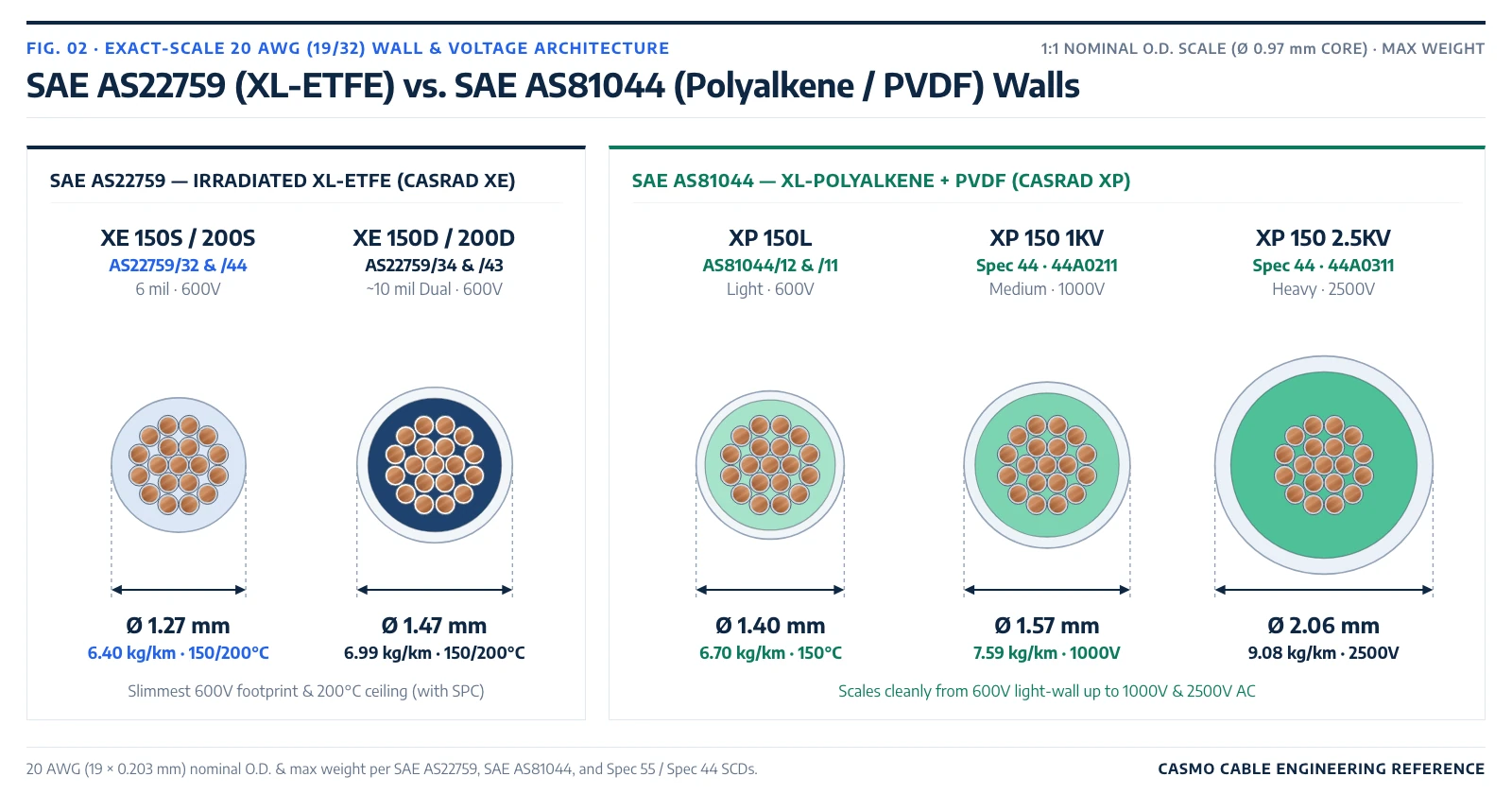
- At 20 AWG (19 × 0.203 mm), single-wall XL-ETFE (CASRAD XE 150S / 200S, 1.27 mm O.D., 6.40 kg/km max) is the lightest 600V aerospace option, followed closely by lightweight dual-wall polyalkene/PVDF (CASRAD XP 150L, 1.40 mm O.D., 6.70 kg/km max) and dual-wall XL-ETFE (CASRAD XE 150D / 200D, 1.47 mm O.D., 6.99 kg/km max).
- Voltage scaling separates the two platforms above 600V: while AS22759 XL-ETFE slash sheets standardize at 600V AC, dual-wall polyalkene/PVDF scales cleanly to 1000V AC (CASRAD XP 150 1KV, 3.0 kV test) and 2500V AC (CASRAD XP 150 2.5KV, 5.0 kV test).
1. Polymer Architecture & Electron-Beam Cross-Linking Physics
Why monolithic XL-ETFE and co-extruded XL-Polyalkene / XL-PVDF replaced legacy thermoplastic hook-up wires
Across aerospace airframes, endurance motorsport cars, unmanned aerial vehicles (UAVs), and defense ground vehicles, primary wiring harnesses face a simultaneous mechanical and thermal squeeze: insulation walls must shrink to 0.15–0.28 mm (6–11 mil) so hundreds of circuits fit through miniature circular connectors, yet those thin walls must survive sharp sheet-metal bulkheads, cable-tie pinch loads, aviation fuels, phosphate-ester hydraulic fluids, and hand-soldering rework without cold-flow or melt-back.
Unirradiated thermoplastics struggle under that combination. Standard PVC softens and deforms above 105°C, extruded PTFE (SAE AS22759/11 and /12) resists 260°C heat and every aerospace fluid but carries a high specific gravity (~2.15 g/cm³) and creeps under sustained mechanical clamp pressure, and unirradiated ETFE (SAE AS22759/16, ASTM D3159) still melts cleanly around 255°C–270°C if touched by a soldering iron or subjected to severe overload.
Both SAE AS22759 cross-linked modified ETFE (the architecture behind TE Connectivity / Raychem Spec 55 and CASMO CASRAD XE) and SAE AS81044 dual-wall polyalkene / PVDF (behind Raychem Spec 44 and CASMO CASRAD XP) solve thermoplastic creep through high-energy electron-beam (e-beam) irradiation. After melt extrusion, accelerated electrons cleave carbon-hydrogen bonds and link adjacent polymer chains into a permanent three-dimensional covalent network. Above its crystalline transition temperature, an e-beam cross-linked wall transitions into a tough rubbery elastomer rather than a liquid — refusing to flow away from conductors during dynamic cut-through or 300°C+ transient heat.
Where the two families diverge is in how they engineer dielectric permittivity, density, and mechanical armor across the wall:
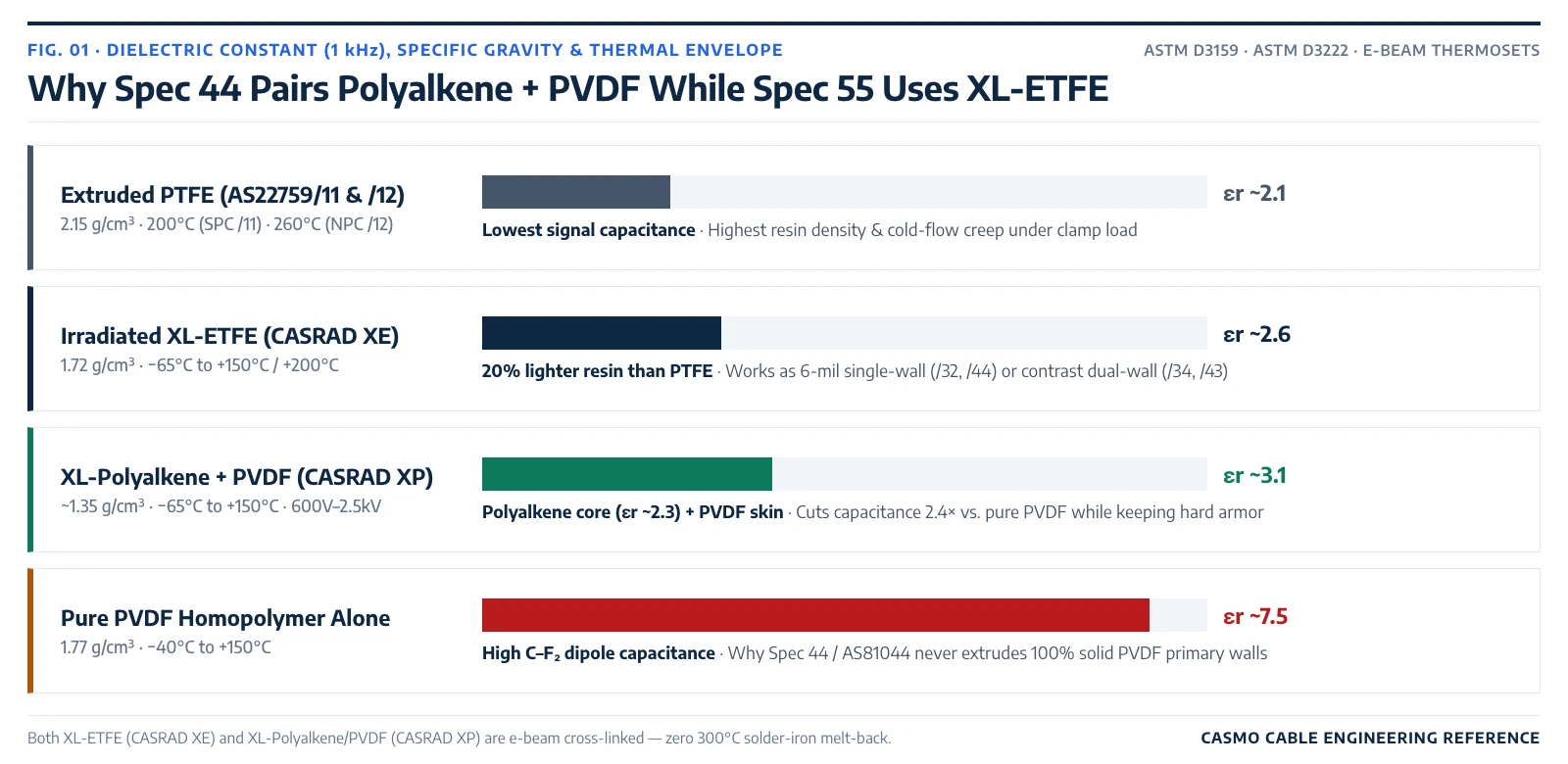
- Monolithic or Dual-Layer XL-ETFE (SAE AS22759/32, /34, /43, /44 — CASRAD XE): Modified ethylene-tetrafluoroethylene copolymer combines ~1.70–1.74 g/cm³ specific gravity (~20% lighter resin than PTFE), inherently low dielectric constant (εr ≈ 2.6 at 1 kHz), broad chemical immunity, and continuous thermal stability up to +200°C when paired with silver- or nickel-plated copper. Because XL-ETFE is already both tough and low-capacitance, it works either as a single 0.15 mm layer (/32, /44) or as two co-extruded contrasting XL-ETFE layers (/34, /43).
- Co-Extruded Composite XL-Polyalkene + XL-PVDF (SAE AS81044/6, /9, /11, /12 — CASRAD XP): Polyvinylidene fluoride (PVDF, ASTM D3222, ρ ≈ 1.76–1.78 g/cm³) exhibits exceptional surface hardness, abrasion resistance, and hydrocarbon barrier performance, but pure homopolymer PVDF has a strongly polar C–F₂ dipole with a dielectric constant of εr ≈ 6.5–8.5 that would load signal lines with high capacitance if extruded as a thick primary wall. SAE AS81044 resolves this by co-extruding a flexible radiation cross-linked polyalkene inner primary dielectric (ρ ≈ 0.95–1.25 g/cm³, εr ≈ 2.3) directly beneath a thin radiation cross-linked modified PVDF copolymer outer jacket — uniting −65°C cold-bend flexibility, low inner capacitance (~3.1 composite εr), and reduced mass with a hard fluoropolymer outer shell.
2. Dimensional, Weight & Voltage Benchmarks at 20 AWG and 22 AWG
Comparing single-wall XE, dual-wall XE, and 600V / 1000V / 2500V XP envelopes on identical conductors
To evaluate connector grommet sealing, backshell bundle diameter, and total airframe or race-car harness mass accurately, engineers should compare both platforms over identical compact concentric stranded conductors (such as 20 AWG 19 × 0.203 mm with 32.4 Ω/km max tinned-copper DCR or 30.2 Ω/km max silver-plated DCR on XE 200S / XP 150L — 30.8 Ω/km on XE 200D — and 22 AWG 19 × 0.160 mm).
At 600V AC RMS on 26–20 AWG signal and light-airframe gauges, lightweight single-wall XL-ETFE (CASRAD XE 150S / 200S, aligned with AS22759/32 and /44 / 55A0111 and 55A0112) achieves the smallest finished diameter at 1.27 ± 0.05 mm (20 AWG) and 1.09 ± 0.05 mm (22 AWG), while 8-mil light-airframe dual-wall XL-ETFE (CASRAD XE 150LA / 200LA, aligned with 55PC0211 and 55PC0212) bridges the gap at 1.37 ± 0.04 mm and 6.80 kg/km max (20 AWG) across 26–2/0 AWG (150LA) and 26–1/0 AWG (200LA). Lightweight dual-wall XL-Polyalkene / PVDF (CASRAD XP 150L, aligned with AS81044/12 and /11 / 44A0111 and 44A0112) places total nominal O.D. at 1.40 ± 0.05 mm (20 AWG, 6.70 kg/km max) — 0.07 mm slimmer and ~4% lighter than normal-weight dual-wall XL-ETFE (CASRAD XE 150D / 200D at 1.47 ± 0.05 mm and 6.99 kg/km max).
Above 600V AC, the polyalkene/PVDF dual-wall platform offers dedicated medium- and heavy-wall dielectric upgrades without switching polymer families: CASRAD XP 150 1KV (aligned with 44A0211, 1000V AC working / 3,000V AC dielectric withstand) finishes at just 1.57 ± 0.05 mm at 20 AWG, while CASRAD XP 150 2.5KV (aligned with 44A0311, 2500V AC working / 5,000V AC withstand) finishes at 2.06 ± 0.08 mm — serving compact traction inverters, downhole logging tools, and high-voltage auxiliary feeders up to 2/0 AWG.
| Parameter (20 AWG, 19 × 0.203 mm) | CASRAD XE 150S / 200S | CASRAD XE 150LA / 200LA | CASRAD XE 150D / 200D | CASRAD XP 150L / 150M | CASRAD XP 150 1KV / 2.5KV |
|---|---|---|---|---|---|
| Reference Spec / SCD | AS22759/32 & /44 · 55A0111 / 0112 | Spec 55PC · 55PC0211 / 55PC0212 | AS22759/34 & /43 · 55A0811 / 0812 | AS81044/12, /11 (/9 Med.) · 44A0111 / 0811 | Spec 44 · 44A0211 (1kV) / 44A0311 (2.5kV) |
| Insulation / Jacket Stack | Single-wall XL-ETFE (0.15 mm 26–20 AWG) | Light-airframe dual-wall XL-ETFE (0.20 mm 26–20 AWG) | Normal dual-wall contrast XL-ETFE (~0.25 mm 26–20 AWG) | XL-Polyalkene core + XL-PVDF jacket | Heavy XL-Polyalkene + XL-PVDF jacket |
| Continuous Temperature | −65°C to +150°C (TPC) / +200°C (SPC) | −65°C to +150°C (TPC) / +200°C (SPC) | −65°C to +150°C (TPC) / +200°C (SPC) | −65°C to +150°C (TPC or SPC) | −65°C to +150°C (TPC) |
| Rated / Test Voltage (AC) | 600V / 2,500V RMS | 600V / 2,500V RMS | 600V / 2,500V RMS | 600V / 2,500V RMS | 1000V (3.0 kV) / 2500V (5.0 kV) |
| 20 AWG Nom. O.D. (mm) | 1.27 ± 0.05 mm | 1.37 ± 0.04 mm | 1.47 ± 0.05 mm | 1.40 ± 0.05 mm (150L) / 1.78 ± 0.08 mm (150M) | 1.57 ± 0.05 mm (1kV) / 2.06 ± 0.08 mm (2.5kV) |
| 20 AWG Max. Weight (kg/km) | 6.40 kg/km | 6.80 kg/km | 6.99 kg/km | 6.70 kg/km (150L) / 8.18 kg/km (150M) | 7.59 kg/km (1kV) / 9.08 kg/km (2.5kV) |
| Available Gauge Span | 30 AWG – 12 AWG | 26–2/0 AWG (150LA) · 26–1/0 AWG (200LA) | 24–2/0 AWG (150D) · 26–2/0 AWG (200D) | 30–12 AWG (150L) · 24–1/0 AWG (150M) | 26–4 AWG (1kV) · 26–2/0 AWG (2.5kV) |
3. Thermal Ceiling, Conductor Plating & Fluid / Environmental Durability
Why silver-plated AS81044/11 stays at 150°C while silver-plated AS22759/43 & /44 unlock 200°C
A frequent specification mistake occurs when engineers assume that upgrading from tin-plated copper (TPC, ASTM B33) to silver-plated copper (SPC, ASTM B298) automatically raises any cross-linked wire from 150°C to 200°C. In reality, continuous temperature rating is capped by whichever element — conductor plating or polymer matrix — hits its thermal-aging ceiling first.
In SAE AS22759 XL-ETFE wires, the cross-linked fluoropolymer matrix itself withstands 200°C continuous aging (and short-term thermal excursions above 300°C per SAE AS4373). Consequently, tin-plated AS22759/32 and /34 (CASRAD XE 150S and 150D) are limited to 150°C strictly by tin-copper intermetallic growth, whereas switching to silver-plated copper in AS22759/44 and /43 (CASRAD XE 200S and 200D) unlocks the full 200°C polymer rating.
In SAE AS81044 polyalkene/PVDF wires, by contrast, the inner cross-linked polyalkene dielectric and outer PVDF jacket (crystalline melt point ~165°C–178°C prior to cross-linking) govern long-term thermal-oxidative life at 150°C continuous. Therefore, silver-plated AS81044/11 (44A0112, supported via CASRAD XP 150L -SS- option) carries the exact same −65°C to +150°C continuous rating as tin-plated AS81044/12 (44A0111, -TS-) — engineers specify the silver-plated /11 variant for lower contact/conductor DCR (30.2 vs. 32.4 Ω/km at 20 AWG), superior solderability, or higher-frequency skin-effect conductivity, not for 200°C heat.
Chemically and mechanically, both families pass stringent SAE AS4373 fluid-immersion, needle-abrasion (Method 301), dynamic cut-through (Method 703), and 60° inclined flame tests (Method 801, alongside IEC 60332-1-2 vertical flame propagation) across Jet A/JP-8 turbine fuel, MIL-PRF-5606 / MIL-PRF-83282 hydraulic oils, lubricating oils, and de-icing fluids. However, prolonged high-temperature exposure to strongly polar ketones, esters, or concentrated caustics favors XL-ETFE over PVDF, which can swell in strong ketone solvents such as acetone or MEK at elevated temperatures.
4. Application Selection Matrix & Naming Hygiene: Avoiding Solar PV Confusion
Matching CASRAD XE and CASRAD XP to aerospace, motorsport, UAV, rail, and industrial harnesses
In practical program architecture, many OEMs standardize both families side by side rather than forcing a single wire across every thermal and voltage zone:
Use CASRAD XE (XL-ETFE) in Zone A high-temperature and ultra-lightweight harnesses: engine nacelles, turbocharger and exhaust-adjacent motorsport looms (200°C XE 200S / 200D), high-density eVTOL/UAV avionics trunks (150°C XE 150S), exposed airframe structural runs needing dual-wall visual chafe detection (XE 150D / 200D), and 200°C shielded sensor buses (CASRAD XE 200MC). Use CASRAD XP (XL-Polyalkene / PVDF) in Zone B rugged 150°C electrical distribution and medium-voltage subsystems: defense tactical vehicles, naval/marine control cabinets, motorsport chassis power distribution, industrial robotics, and 1000V / 2500V inverter or auxiliary power harnesses (CASRAD XP 150L, 150M, 150 1KV, 150 2.5KV, and shielded XP 150MC / 150MC 1KV).
One important nomenclature note for procurement teams: although SAE AS81044 outer jackets use cross-linked polyvinylidene fluoride (abbreviated PVDF), these aerospace/industrial dual-wall wires are completely unrelated to UL 4703 / EN 50618 outdoor Solar Photovoltaic (PV) DC string cables. CASMO designates its cross-linked polyalkene/PVDF platform CASRAD XP specifically to keep aerospace and motorsport dual-wall specifications cleanly separated from 1.5 kV outdoor solar PV cables. Likewise, CASRAD XE and XP series are manufactured as commercial, motorsport, UAV, and industrial functional equivalents (non-QPL); contracts requiring formal NAVAIR QPL/QPD lot certification must verify QPL listing status separately.
Frequently Asked Questions
- Can SAE AS81044 (Spec 44 / CASRAD XP) substitute for SAE AS22759/32 (Spec 55 / CASRAD XE 150S) in 150°C harnesses?
- Electrically both are rated −65°C to +150°C and 600V AC with tinned copper conductors, and both resist soldering heat and aerospace fluids. However, verify connector rear grommet sealing and bundle diameter before substituting: at 20 AWG, lightweight AS81044/12 (CASRAD XP 150L) has a 1.40 mm nominal O.D. versus 1.27 mm on single-wall AS22759/32 (CASRAD XE 150S) and 1.47 mm on dual-wall AS22759/34 (CASRAD XE 150D). Also avoid PVDF jackets where continuous hot ketone/MEK immersion is present.
- Why does AS81044/11 (44A0112) use silver-plated copper if its temperature rating is still 150°C?
- In AS81044/11, the 150°C ceiling is set by the cross-linked polyalkene/PVDF insulation system rather than the conductor. Silver-plated copper (ASTM B298) is specified when circuits require ~6%–7% lower DC resistance (e.g., 30.2 vs. 32.4 Ω/km at 20 AWG), lower high-frequency skin-effect loss, or faster solder wetting than tin-plated copper.
- Why does Spec 44 / AS81044 use a polyalkene inner core instead of 100% solid PVDF insulation?
- Pure PVDF has a high dielectric constant (εr ≈ 6.5–8.0) and higher density (~1.77 g/cm³), which would increase line-to-line capacitance, capacitive crosstalk, and wire weight if extruded across the full wall. Pairing a low-permittivity cross-linked polyalkene primary core (εr ≈ 2.3) with a thin cross-linked PVDF outer jacket lowers composite permittivity near ~3.1 while retaining PVDF's hard cut-through shell.
- Which cross-linked wire family supports 1000V and 2500V AC ratings without jumping to bulky industrial rubber cable?
- The dual-wall cross-linked polyalkene/PVDF family scales directly to 1000V AC (CASRAD XP 150 1KV, aligned with 44A0211, 3,000V test) and 2500V AC (CASRAD XP 150 2.5KV, aligned with 44A0311, 5,000V test), keeping a 20 AWG 2.5 kV wire down to just 2.06 mm nominal O.D.
- How do XL-ETFE and XL-Polyalkene/PVDF behave under gamma or electron-beam radiation compared to PTFE?
- Polytetrafluoroethylene (PTFE) undergoes rapid main-chain scission and embrittlement at relatively low radiation doses (~10³–10⁴ Gy). Both cross-linked ETFE and cross-linked polyalkene/PVDF exhibit roughly one to two orders of magnitude higher radiation tolerance (commonly serviceable into the 10⁵–10⁶ Gy range depending on dose rate and oxygen), making them preferred over PTFE in spacecraft, particle-accelerator, and nuclear instrumentation zones.
- Are CASMO CASRAD XE and CASRAD XP wires QPL-listed for military aircraft?
- CASRAD XE and CASRAD XP wires are manufactured to the dimensional, material, and electrical envelopes referenced by SAE AS22759, SAE AS81044, and NEMA WC 27500 for commercial aerospace prototyping, motorsport, UAV/eVTOL, rail, marine, and industrial equipment (non-QPL). Programs contractually mandating NAVAIR QPL/QPD lot release should confirm QPL requirements prior to ordering.
Regulatory & Engineering References
- SAE International — SAE AS22759 (Wire, Electrical, Fluoropolymer-Insulated, Copper or Copper Alloy) and slash sheets AS22759/32, /34, /43, and /44.
- SAE International — SAE AS81044 (Wire, Electrical, Crosslinked Polyalkene, Crosslinked Alkane-Imide Polymer, or Polyarylene Insulated, Copper or Copper Alloy) and slash sheets /6, /9, /11, and /12.
- SAE International — SAE AS4373 (Test Methods for Insulated Electric Wire, including Method 301 Needle Abrasion and Method 703 Dynamic Cut-Through).
- ASTM International — ASTM D3159 (Modified ETFE Fluoropolymer Molding and Extrusion Materials) and ASTM D3222 (Unmodified Polyvinylidene Fluoride Molding Extrusion and Coating Materials).
- ASTM International — ASTM B33 (Tin-Coated Soft or Annealed Copper Wire) and ASTM B298 (Silver-Coated Soft or Annealed Copper Wire).
- NASA Technical Standard — NASA-STD-8739.4 (Workmanship Standard for Crimping, Interconnecting Cables, Harnesses, and Wiring).