Custom Engineering · 11 min read · Reviewed by CASMO Cable Engineering Team · Updated 2026-11-26
Direct Engineering Answer
Effective January 1, 2025 under UL Solutions' updated surface-marking requirements for Recognized Appliance Wiring Material (Category Control Numbers AVLV2 in the United States and AVLV8 in Canada), every certified AWM measuring ≥ 1.3 mm (0.051 in) in finished outer diameter — or ≥ 1.3 mm in major cross-sectional dimension (overall width) for non-round constructions — must carry continuous, durable surface printing containing three core traceability elements: (1) the official graphical UL Recognized Component Mark (RU, cRU, or authorized cRUus — never plain typed ASCII letters), (2) the literal designation 'AWM', and (3) the UL File Number (such as CASMO File E535175) or responsible party identifier alongside any applicable factory identification code or symbol where required. Round micro-wires measuring strictly < 1.3 mm in finished outer diameter (such as 30–28 AWG UL 1571, UL 1061, UL 1007, UL 1180, and UL 1332) are exempt from mandatory wire-surface printing because tight curvature prevents legible graphical mark reproduction, while 100% of shipments must carry complete UL 758 Section 51 certification markings on the smallest shipping spool, reel, or carton tag. Conversely, flat parallel ribbon cables (such as UL 2651, UL 20080, UL 4478, and UL 20297) are evaluated by finished overall ribbon width rather than sub-1.3 mm core thickness, meaning standard ribbon configurations ≥ 1.3 mm in width require surface printing.
Key Engineering Takeaways
- Effective January 1, 2025 under UL Solutions' CCN AVLV2 (US) and AVLV8 (Canada) requirements, all certified AWM ≥ 1.3 mm in round outer diameter or non-round major dimension must display the official graphical RU / cRU (or cRUus) Recognition Mark, 'AWM', and UL File Number (CASMO File E535175) or responsible party plus any applicable factory identification symbol.
- Round hook-up wires strictly < 1.3 mm in finished O.D. (including 30–28 AWG UL 1571, UL 1061, UL 1007, and silver-plated or nickel-plated UL 1180 / UL 1332 fluoropolymer micro-leads) do not require wire-surface printing; incoming QA verifies certification via the mandatory UL 758 Section 51 smallest-unit spool tag.
- Never evaluate flat ribbon cables by insulation thickness: for planar constructions, the major cross-sectional dimension is finished overall ribbon width W (W ≈ Pitch × N), so even a 2-conductor 1.27 mm pitch ribbon (W = 2.54 mm) or 4-conductor 0.635 mm micro-pitch ribbon (W = 2.54 mm) exceeds 1.3 mm and requires longitudinal surface printing.
- Exact surface-print token order, Canadian Class/Group codes (e.g., I A vs. I/II A/B), flame ratings (VW-1 / FT1 vs. FT2), and factory identification symbols vary legitimately by UL Style, manufacturing site, and production date (including pre-January 1, 2025 legacy inventory backed by Section 51 spool tags).
1. What Changed on January 1, 2025 for UL / cUL AWM Surface Marking (CCN AVLV2 & AVLV8)?
Decoding a representative CASMO dual-recognized surface legend and UL Mark integrity rules
Historically, Section 50.1 of UL 758 treated continuous wire-surface printing as optional on many single-conductor Appliance Wiring Material (AWM) styles unless mandated by an individual Style page or Canadian CSA C22.2 No. 210 Clause 12 rules. In practice, OEM harness shops and equipment builders routinely encountered unprinted fluoropolymer, silicone, or PVC hook-up leads — or partial legends citing an E-number without a graphical UL mark — making it difficult for field engineers and incoming quality control (IQC) teams to distinguish genuine UL-recognized wire from uncertified look-alikes once stripped off a master reel.
Effective January 1, 2025, UL Solutions updated its Category Control Number AVLV2 (US Component AWM) and AVLV8 (Canadian cUL Component AWM) surface-marking requirements to strengthen supply-chain traceability. For all certified AWM measuring ≥ 1.3 mm (0.0512 in) in finished outer diameter or major cross-sectional dimension, surface printing must incorporate the graphical Recognition Mark, 'AWM', and UL File or responsible-party identification (with applicable factory identification where required), working alongside UL 758 Section 50 and CSA C22.2 No. 210 rating elements. Below is a representative dual-recognized CASMO legend illustrating how these elements appear together (note that exact token order, class/flame codes, and factory symbols vary by UL Style and lot):
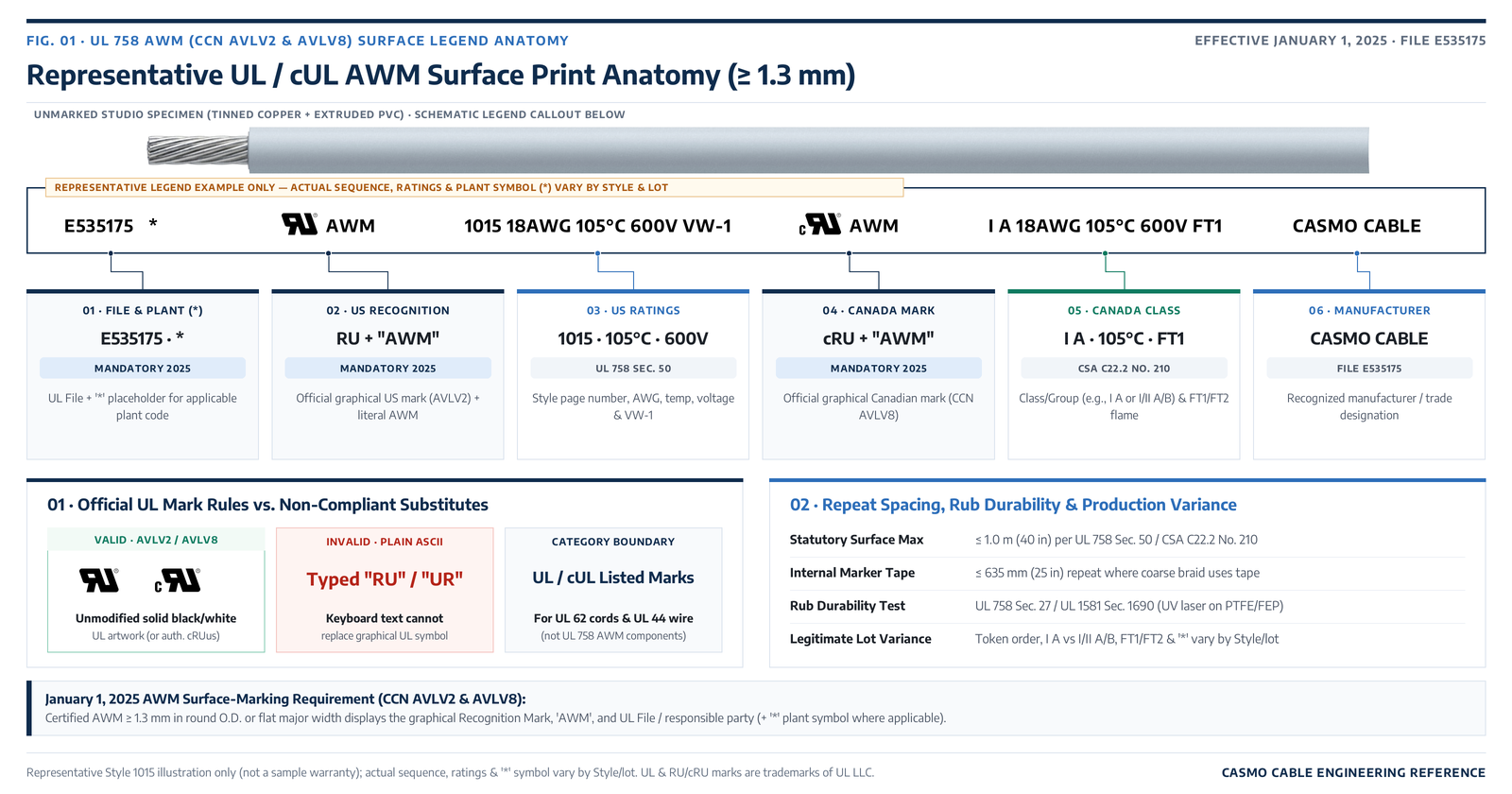
- Core Traceability Element 1 — Official Graphical Recognition Mark (RU, cRU, or Authorized cRUus): Wires recognized for the United States (AVLV2) display the graphical backward-UR Recognition Mark (RU); wires recognized for Canada (AVLV8) display cRU (as shown side-by-side in CASMO's dual-recognized File E535175 legends, or via a combined cRUus mark where authorized). Plain keyboard ASCII letters ('RU', 'UR', or typed 'cRUus') are invalid substitutes. Likewise, circular UL or cUL Listed marks belong strictly to finished portable cords (UL 62, CASMO File E546631) and thermoset building wires (UL 44, CASMO File E550452) — never UL 758 AWM component styles.
- Core Traceability Element 2 — Literal 'AWM' Category Designation: Identifies the wire as an Appliance Wiring Material component intended for factory installation inside certified end-use equipment (such as UL 508A control panels, UL 62368-1 IT/power electronics, or UL 60335 appliances) rather than standalone NEC chapter-3 building conduit wiring.
- Core Traceability Element 3 — UL File Number or Responsible Party + Applicable Factory Symbol ('*'): Links the wire to an active UL Product iQ listing — such as CASMO File E535175 and trade name CASMO CABLE — accompanied by the UL-assigned factory identification code or symbol (represented generically by '*' in illustrative legends) where a file covers multiple authorized facilities.
- Companion Engineering Rating Tokens (UL 758 Sec. 50 & CSA C22.2 No. 210 Clause 12): Specific Style numbers (e.g., 1015, 1007, 20267), conductor AWG size, rated temperature (°C), rated voltage (V), US flame rating (VW-1, FT1, or FT2), and Canadian cUL class/group designations (such as I A for internal electronic wiring or I/II A/B for dual internal/external appliance wiring) follow individual UL Style pages and CSA C22.2 No. 210 — so legitimate production reels naturally differ in exact rating strings and token order across styles.
- Repeat Spacing & Rub Durability (UL 758 Sec. 27 & Sec. 50): Statutory outer-surface repeat limits permit up to ≤ 1.0 m (40 in) under UL 758 Section 50 / CSA C22.2 No. 210 (and ≤ 635 mm / 25 in on internal marker tapes), while modern extrusion lines typically repeat legends every 150–300 mm (6–12 in) and verify abrasion resistance to UL 1581 Section 1690.
2. The 1.3 mm Threshold Explained: Why Fine Round Wires (< 1.3 mm) Are Surface-Print Exempt
Exact geometric outer-diameter math across PVC and 200°C fluoropolymer hook-up styles
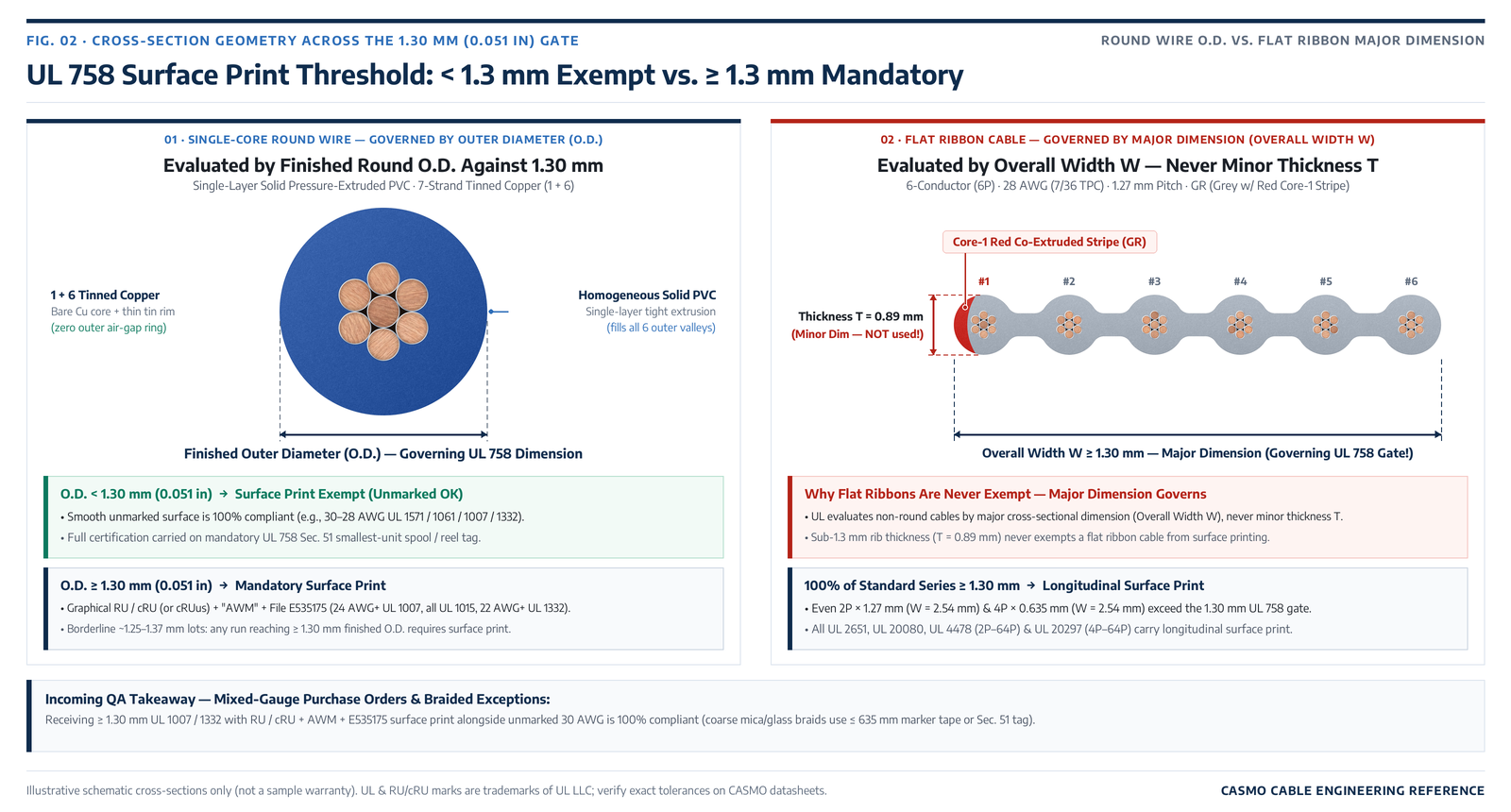
A frequent question from harness engineers and incoming QA inspectors is whether UL AWM wires smaller than 1.3 mm require surface printing. Under UL Solutions' CCN AVLV2 / AVLV8 marking rules, round single-conductor or multiconductor AWM cables with a finished outer diameter strictly below 1.3 mm (0.0512 in) are exempt from mandatory wire-surface printing. Below 1.3 mm, tight insulation curvature prevents rotary ink wheels and continuous inkjet (CIJ) droplets from forming an undistorted, rub-resistant graphical backward-UR mark without wrapping around the circumference or compromising thin dielectric walls.
Because the 1.3 mm gate applies to finished outer diameter rather than an entire UL Style family, a single Style frequently splits across unmarked fine gauges and surface-printed larger gauges. Using standard ASTM B258 / B286 7-strand concentric conductor geometry (d_cond = 3 × d_strand) plus twice the UL 758 Style page minimum average wall thickness (O.D._min = d_cond + 2 × t_wall), engineers can predict where each CASMO UL File E535175 hook-up series crosses the 1.30 mm threshold:
| CASMO UL 758 Series (File E535175) | Ratings & Conductor Metallurgy | UL 758 Wall Requirement | Strictly < 1.30 mm O.D. (Surface Print Exempt) | Borderline Band (~1.24–1.37 mm) | Strictly ≥ 1.30 mm (Surface Print Mandatory) |
|---|---|---|---|---|---|
| UL Style 1571 | 80°C · 30V AC · SR-PVC / PVC (TPC / BC) | 2 mils (0.05 mm) min at any point (~4–6.5 mil commercial wall) | 32–22 AWG (~0.45–1.15 mm nominal O.D.) | 20 AWG (~1.17–1.35 mm depending on specified wall) | 18–16 AWG (~1.42–1.90 mm nominal O.D.) |
| UL Style 1061 | 80°C · 300V AC · Semi-Rigid SR-PVC (TPC / BC) | 9 mils (0.23 mm) min avg; 7 mils min point | 30–24 AWG (0.76 mm floor; ~0.80–1.18 mm nominal O.D.) | 22 AWG 7/30 (1.22 mm floor; ~1.25–1.30 mm nominal) | 20–14 AWG (1.42 mm floor; ~1.45–2.50 mm nominal O.D.) |
| UL 1007 / UL 1569 | 80°C / 105°C · 300V AC · Flexible PVC (TPC / BC) | 15 mils (0.38 mm) min avg; 13 mils min point | 32–28 AWG (1.00–1.14 mm floor; ~1.05–1.25 mm nominal) | 26 AWG 7/34 (1.24 mm floor; ~1.25–1.34 mm nominal) | 24–16 AWG UL 1007 & 14–10 AWG UL 1569 (≥ 1.37 mm) |
| UL Style 1015 | 105°C · 600V AC · Heavy-Wall PVC (TPC / BC) | 30 mils (0.76 mm) min avg; 27 mils min point | None — 2 × 0.76 mm wall alone equals 1.52 mm | None across standard gauge range | 100% of gauges from 30 AWG upward (≥ 1.83 mm O.D.) |
| UL 1332 (FEP) & UL 1180 (PTFE) | 200°C · 300V AC · SPC (-SS-) standard or 2% NPC (-NS-) | 13 mils (0.33 mm) min avg; 12 mils min point | 30–26 AWG (0.96–1.14 mm floor; ~1.00–1.24 mm nominal) | 24 AWG 7/32 (1.27 mm floor; ~1.27–1.37 mm nominal) | 22 AWG upward (≥ 1.42 mm; UL 1180 extruded PTFE ≤ 6.5 mm O.D.) |
| UL 2651 / 20080 / 4478 / 20297 | 80°C–105°C · 300V · Flat Parallel Ribbon (PVC / XLPE / TPE) | Evaluated by overall ribbon Width W (major dimension) | None in standard CASMO 2P–64P / 4P–64P series | Theoretical 2P × 0.635 mm zip only (W = 1.27 mm) | All 1.00–1.30 mm pitch (2P–64P) & 0.635 mm (4P–64P) ribbons |
Engineering Tip on Borderline Gauges & 200°C Fluoropolymers: On straddling sizes such as 26 AWG UL 1007 (~1.25–1.34 mm) and 7-strand 24 AWG UL 1332 / UL 1180 (~1.27–1.37 mm), positive extrusion tolerance frequently pushes finished O.D. to ≥ 1.30 mm; applying compliant surface marking proactively eliminates inspection ambiguity. Note also per UL 758 Table 5.2 that 200°C fine-strand UL 1180 and UL 1332 conductors use silver-plated copper (-SS-) or 2% nickel-plated copper (-NS-) rather than tinned copper.
3. The Flat Ribbon 'Major Dimension' Trap & Special Fluoropolymer / Braided Surfaces
Why sub-millimeter ribbon thickness never exempts planar IDC cables, plus UV laser and fiberglass braid solutions
The most common misinterpretation of the 2025 UL AWM surface-marking threshold occurs on flat parallel ribbon cables. Engineers measuring a 28 AWG 1.27 mm (0.050 in) pitch ribbon cable (such as PVC UL 2651, rainbow PVC UL 20080, cross-linked halogen-free XLPE UL 4478, or halogen-free TPE UL 20297) see a nominal insulation thickness near 0.89–0.90 mm and mistakenly assume the cable falls below 1.3 mm. However, UL evaluates the 1.3 mm threshold by outer diameter on round wires and by major cross-sectional dimension on non-round or planar constructions — which is the finished overall ribbon width W, never the minor thickness T.
Even on a 2-conductor (2P) 1.27 mm pitch parallel zip wire, overall width equals W = 2 × 1.27 mm = 2.54 mm (nearly double the 1.30 mm threshold), while a 10-conductor (10P) IDC ribbon measures 12.70 mm wide and a 4-conductor (4P) 0.635 mm micro-pitch UL 20297 ribbon measures 2.54 mm wide. Consequently, 100% of CASMO standard flat ribbon series (as well as round-jacketed RoundFlat IDC cables under UL 20267, UL 20276, and LSZH UL 21307 / UL 4478, whose outer jacket diameters span ~5.0–11.5 mm) carry compliant surface marking — typically printed longitudinally along the flat web face away from the Core-1 polarity edge stripe.
High-temperature constructions ≥ 1.3 mm introduce two distinct physical surface-marking challenges solved through dedicated manufacturing methods:
- Low-Surface-Energy Fluoropolymers ≥ 1.3 mm (PTFE UL 1180 / 1199 / 1213, FEP UL 1330 / 1332, PFA UL 1726 / 1727 / 10362): Conventional solvent inks bead up and rub off slick perfluoropolymer surfaces during UL 758 Section 27 / UL 1581 Section 1690 abrasion testing. On ≥ 1.3 mm fluoropolymer leads, CASMO employs non-contact 355 nm ultraviolet (UV) cold-laser photochemical marking or high-temperature sintered fluorocarbon inks, producing permanent, zero-indent RU / cRU AWM and File E535175 legends without degrading thin-wall dielectric withstand.
- Coarse Fiberglass & Mica-Tape Braided High-Heat Leads (UL 5107 / 5128 / 5335 MGT and UL 3122 / 3513 Silicone-Glass under File E535175, plus industry TGGT styles): Woven fiberglass outer braids present an open, textured weave that cannot hold sharp graphical RU mark ink impressions. Where surface printing is physically impractical on fibrous braids, UL 758 Section 50 and authorized UL Follow-Up Services procedures allow either an internal printed high-temperature marker tape beneath the braid (repeating at ≤ 635 mm / 25 in intervals) or authorized spool/tag identification on ultra-high-temperature 450°C–550°C inorganic mica-glass constructions where organic marker tapes would char.
- Voluntary Micro-Printing Below 1.3 mm: Although < 1.3 mm wires are exempt from mandatory surface legends, if an OEM specification requests custom micro-laser printing on a sub-1.3 mm wire and invokes UL AWM recognition on the surface, all printed elements must remain legible and conform to UL 758 Section 50 without partial or altered mark artwork.
4. Incoming Quality Control (IQC) Playbook: Spool Tags (UL 758 Sec. 51), Legacy Stock & Product iQ
Preventing false receiving holds on mixed-gauge orders, pre-2025 inventory, and style-specific legends
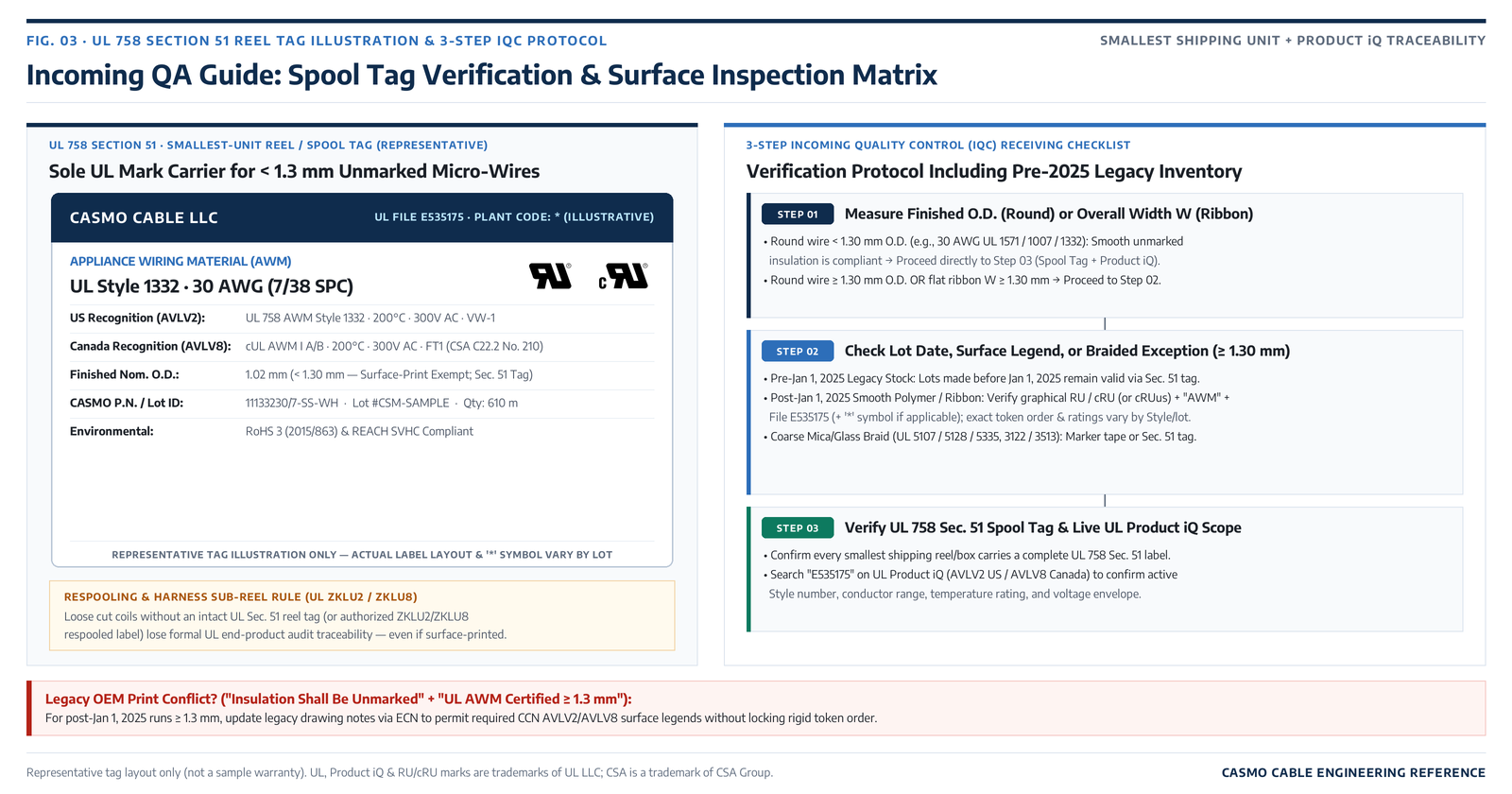
With the January 1, 2025 AWM surface-marking requirement active across global supply chains, OEM incoming inspection teams should guard against two common pitfalls: falsely quarantining legitimate < 1.3 mm unmarked micro-wires (or valid pre-January 1, 2025 legacy inventory reels), or conversely accepting uncertified loose coils ≥ 1.3 mm that lack both graphical RU/cRU marks and valid UL 758 Section 51 packaging labels.
Crucially, mandatory surface printing on ≥ 1.3 mm wire never replaces UL 758 Section 51 packaging rules. Under UL 758 Section 51, 100% of certified AWM shipments — whether < 1.3 mm unmarked, pre-2025 legacy stock, or ≥ 1.3 mm surface-printed — must carry full certification markings (graphical RU / cRU mark, 'AWM', Style number, voltage, temperature, gauge, flame rating, and UL File / responsible party plus any applicable factory code) on the tag, reel flange, or smallest unit carton. Furthermore, if a distributor or harness subcontractor respools wire from a master factory reel onto smaller sub-reels, Section 51 requires transferring complete tag traceability under UL's Processed Wire — Respooled program (CCN ZKLU2 for the US and ZKLU8 for Canada).
| Incoming Shipment Scenario | Wire Surface Appearance | UL 758 Sec. 51 Spool / Carton Tag | IQC Receiving Disposition & Action |
|---|---|---|---|
| Round AWM strictly < 1.30 mm O.D. (e.g., 30 AWG UL 1571 / 1007 / 1332) | Smooth unmarked insulation | Present with graphical RU/cRU, Style, ratings & File E535175 | PASS — Exempt from surface print (< 1.3 mm); retain spool tag with lot traveler for UL end-product audit. |
| Round AWM ≥ 1.30 mm O.D. or Flat Ribbon W ≥ 1.30 mm (manufactured on/after Jan 1, 2025) | Graphical RU / cRU (or cRUus) + 'AWM' + File E535175 (+ '*' plant code where applicable) | Present on smallest shipping reel or carton | PASS — Compliant with Jan 1, 2025 CCN AVLV2/AVLV8 surface marking and UL 758 Sec. 50 / 51 (token order varies by Style/lot). |
| Pre-January 1, 2025 legacy inventory lot ≥ 1.30 mm O.D. | Printed under prior format or unmarked per historical Sec. 50.1 | Present with pre-2025 manufacture lot/date & File E535175 | PASS — Lots manufactured prior to Jan 1, 2025 remain valid under UL 758 Sec. 51 spool-tag traceability. |
| Post-2025 smooth extruded AWM ≥ 1.30 mm with typed ASCII 'RU' only or missing mark | Plain keyboard letters without graphical backward-UR symbol (or blank) | Present or missing | HOLD / VERIFY — Non-compliant for post-Jan 1, 2025 smooth extruded AWM ≥ 1.30 mm; contact supplier QA. |
| High-temp coarse mica/fiberglass braid ≥ 1.30 mm (e.g., UL 5107 / 5128 / 5335, UL 3122 / 3513) | Unprinted woven glass braid (internal marker tape ≤ 635 mm or authorized tag ID) | Present with RU/cRU, Style, ratings & File E535175 | PASS — Verify internal printed marker tape where applicable and retain Section 51 spool tag. |
| Respooled sub-reel or loose coil (any gauge) missing UL reel tag | Printed or unprinted | Missing (or plain warehouse sticker without ZKLU2/ZKLU8 coverage) | HOLD — Request factory CoC / master-reel traceability or ZKLU2/ZKLU8 Processed Wire label before UL panel build. |
5. Resolving Legacy OEM Drawing Conflicts ('No Surface Marking' Callouts)
How engineering teams update legacy print notes without delaying harness production
Many industrial, semiconductor-equipment, appliance, and instrumentation OEMs maintain legacy wire harness drawings drafted 10 to 20 years ago that simultaneously specify two now-conflicting notes on ≥ 1.3 mm hook-up leads: Note A requires 'Wire shall be UL/cUL Recognized to UL 758 Style 1007 / 1015 / 1332,' while Note B specifies 'Insulation surface shall be unmarked / clean solid color only' (originally intended to reserve space for post-extrusion harness circuit hot-stamping).
For production lots manufactured on or after January 1, 2025, certified ≥ 1.3 mm smooth-extruded AWM must carry the required graphical Recognition Mark, 'AWM', and UL File or responsible-party surface legend. When updating legacy BOMs or clearing first-article inspections, engineering teams have three clean paths:
- Path 1 — Issue a Streamlined Drawing ECN (Recommended): Amend the legacy 'unmarked insulation' drawing note to permit mandatory UL/cUL AWM surface compliance legends (CCN AVLV2 / AVLV8) without locking the print note to a rigid character-for-character layout. Modern low-profile ink-jet or contrast-controlled UV laser legends leave ample circumferential clarity for downstream circuit-ID marking or heat-shrink sleeves.
- Path 2 — Orient Surface Print Away from Circuit Coding on Flat & Custom Cables: On flat ribbon cables (UL 2651, UL 4478, UL 20297) and custom OEM-jacketed cables, CASMO aligns the statutory RU / cRU AWM and File E535175 legend cleanly along one face or alongside custom OEM part numbers so automated optical harness inspection cameras experience zero interference.
- Path 3 — Supply Non-UL Build-to-Print Spec Wire Only Where Agency Recognition Is Not Required: If an internal non-agency assembly strictly forbids any surface ink or laser contrast on a ≥ 1.3 mm wire, the wire must be ordered and labeled strictly as non-UL custom build-to-print hook-up wire without UL/cUL AWM claims on the spool tag or CoC.
Frequently Asked Questions
- Do UL 758 AWM wires smaller than 1.3 mm in outer diameter require surface printing?
- No. Under UL Solutions' January 1, 2025 AWM surface-marking requirements (CCN AVLV2 and AVLV8), mandatory wire-surface printing applies to AWM measuring ≥ 1.3 mm (0.051 in) in round outer diameter or non-round major dimension. Round micro-wires strictly < 1.3 mm in finished O.D. (such as 30–28 AWG UL 1571, UL 1061, UL 1007, UL 1180, and UL 1332) may ship with smooth unmarked insulation, provided the smallest shipping spool, reel, or carton carries full UL 758 Section 51 certification markings.
- Does a flat ribbon cable with 0.89 mm thickness qualify for the < 1.3 mm surface-print exemption?
- No. UL evaluates the 1.3 mm threshold by outer diameter on round wires and by major cross-sectional dimension on flat or non-round constructions. On flat parallel ribbon cables (such as UL 2651, UL 20080, UL 4478, and UL 20297), the major cross-sectional dimension is the finished overall ribbon width W rather than insulation thickness. Because even a 2-conductor 1.27 mm pitch ribbon (W = 2.54 mm) or 4-conductor 0.635 mm micro-pitch ribbon (W = 2.54 mm) exceeds 1.3 mm, standard flat ribbon cables require surface printing.
- Can plain keyboard letters 'RU' replace the official graphical UL Recognition Mark, or what if our reel print order differs slightly from Fig. 1?
- Plain ASCII keyboard letters 'RU' or 'UR' cannot substitute for the official graphical UL Recognized Component symbol (backward-UR artwork for RU, cRU, or authorized cRUus). However, UL 758 does not lock every Style and facility into one identical character sequence: legitimate production reels vary in token order, US-only vs. dual US/Canadian segments, Canadian Class/Group codes (I A vs. I/II A/B), flame ratings (VW-1 / FT1 vs. FT2), and UL-assigned factory symbols ('*'), and lots manufactured prior to January 1, 2025 remain valid under UL 758 Section 51 spool tags.
- Why did 22 AWG UL 1007 arrive with surface printing while 30 AWG UL 1007 on the same PO arrived unmarked?
- Both reels are 100% compliant. Within UL 1007 (15-mil minimum average PVC wall), 22 AWG has a nominal finished O.D. near 1.60 mm (≥ 1.3 mm, requiring surface print), whereas 30 AWG has a nominal finished O.D. near 1.12 mm (< 1.3 mm, surface-print exempt). Verify the 30 AWG spool via its mandatory UL 758 Section 51 reel flange label referencing CASMO UL File E535175.
- How are high-temperature PTFE/FEP wires and fiberglass-braided MGT wires marked above 1.3 mm?
- For smooth ≥ 1.3 mm fluoropolymer wires (such as 22 AWG and larger UL 1180 PTFE, UL 1332 FEP, and UL 1727 PFA), CASMO uses 355 nm UV cold-laser marking or sintered fluorocarbon ink so the graphical RU / cRU marks pass UL 1581 Section 1690 rub testing. For coarse fiberglass or mica-braided wires (such as UL 5107, UL 5128, UL 5335, UL 3122, and UL 3513 under File E535175) where woven glass cannot hold legible ink, UL 758 Section 50 and authorized Follow-Up Services procedures provide for internal printed marker tape (≤ 635 mm repeat) or spool-tag identification.
- How can incoming QA verify CASMO UL File E535175 online?
- Inspectors can download CASMO's US (AVLV2) and Canadian (AVLV8) certificates directly from the CASMO Quality & Compliance page or search File E535175 on UL Solutions Product iQ to confirm active Style numbers, AWG ranges, voltage ratings, and temperature envelopes.
Regulatory & Engineering References
- UL Solutions — Product iQ Category Guide Information for Appliance Wiring Material – Component (CCN AVLV2 for the United States; CCN AVLV8 for Canada), including January 1, 2025 AWM surface-marking requirements.
- UL Standards & Engagement — UL 758 (Standard for Safety for Appliance Wiring Material, Edition 3): Table 5.2 (Conductor Temperature Limits), Section 27 (Durability of Ink-Print), Section 50 (Surface Marking of AWM), and Section 51 (Markings on Tag, Reel, or Carton).
- CSA Group — CSA C22.2 No. 210 (Appliance Wiring Material Products, Clause 12 Markings — Class I/II, Group A/B cUL AWM evaluation under CCN AVLV8).
- UL Standards & Engagement — UL 1581 (Reference Standard for Electrical Wires, Cables, and Flexible Cords, Section 1690 Indelible-Ink Printing Test) & UL Processed Wire — Respooled Categories (ZKLU2 / ZKLU8).
- ASTM International — ASTM B258 (Standard Specification for Standard Nominal Diameters and Cross-Sectional Areas of AWG Sizes), ASTM B33 (Tinned Copper), ASTM B298 (Silver-Coated Copper), and ASTM B355 (Nickel-Coated Copper).
Illustrative Print & Trademark Notice: Surface-print strings, token sequences, factory identification placeholders ('*'), and spool-tag layouts shown in this guide are representative engineering illustrations only and do not constitute an express warranty by sample or description (Cal. Com. Code § 2313). Actual production markings on shipped CASMO reels may vary in token sequence, spacing, typography, Canadian Class/Group or flame designations (e.g., I A vs. I/II A/B; VW-1 / FT1 vs. FT2), US-only vs. dual US/Canadian scope, UL-assigned factory identification symbols, or pre-January 1, 2025 legacy lot status while conforming to CASMO's authorized UL Follow-Up Services procedure, UL 758 Sections 50–51, and approved specification sheets. UL, the UL logo, Product iQ, and UL certification marks (including the UL Listed and UL Recognized Component Marks) are trademarks of UL LLC. CSA is a trademark of CSA Group. Component Recognition under UL File E535175 covers component wire evaluation only and does not imply UL endorsement or standalone end-product UL Listing.