High-Temperature Materials · 12 min read · Reviewed by CASMO Cable Engineering Team · Updated 2026-11-24
Direct Engineering Answer
Although NEMA HP 3 and SAE AS22759 both govern high-temperature fluoropolymer single-conductor wires, they serve distinct operational domains and qualification regimes. Choose NEMA HP 3 (Types ET 250V / 6 mil, Type E 600V / 10 mil, Type EE 1000V / 15 mil — superseding commercial extruded-PTFE slash sheets of cancelled MIL-W-16878) for high-reliability internal chassis wiring, test instrumentation, industrial sensors, and commercial high-temperature equipment up to 200°C (silver-plated copper) or 260°C (nickel-plated copper). Choose SAE AS22759 (superseding MIL-W-22759) for aerospace airframe, avionics, and weight-sensitive defense harnesses where every individual slash sheet locks one exact insulation system (extruded PTFE on /9–/12, extruded ETFE on /16, or radiation cross-linked XL-ETFE on /32, /34, /41, /43), conductor alloy/plating, and tight O.D. weight budget — always verifying upfront whether your program requires formal NAVAIR QPL/QPD listing or commercial-equivalent construction to AS22759 specifications.
At-a-Glance Specification Verdict — NEMA HP 3 (Legacy MIL-W-16878) vs. SAE AS22759
NEMA HP 3 (Legacy MIL-W-16878)
Extruded PTFE · Types ET (250V) / E (600V) / EE (1000V) · 200°C–260°C
- Internal electronic chassis, laboratory instrumentation, industrial furnaces, and commercial equipment wiring
- Legacy BOMs referencing M16878/4, /5, /6, /23, /25, or /27 needing direct extruded-PTFE commercial continuity
Limitation: Commercial/equipment standard only; does not carry airframe scrape-abrasion qualification or NAVAIR QPL status
SAE AS22759 (Legacy MIL-W-22759)
PTFE / ETFE / XL-ETFE Slash Sheets · 600V–1000V · 150°C–260°C
- Aerospace airframe, avionics, UAV, and defense harnesses prioritizing tight O.D., low weight, and fluid/abrasion endurance
- Designs specifying exact slash sheets (/11, /12 PTFE; /16 ETFE; /32, /34, /41, /43 XL-ETFE) or SAE AS27500 cores
Limitation: Formal QPL/QPD qualification is administered per slash sheet and AWG — verify QPL vs. construction-equivalent scope at RFQ
Key Engineering Takeaways
- Legacy MIL-W-16878 was cancelled for new design and its commercial extruded-PTFE hook-up wire types transferred to NEMA HP 3 (Types ET, E, and EE), while legacy airframe specification MIL-W-22759 transitioned to SAE AS22759.
- NEMA HP 3 focuses exclusively on extruded PTFE insulation across three clean wall/voltage tiers: Type ET (250V, 6 mil nominal), Type E (600V, 10 mil nominal), and Type EE (1000V, 15 mil nominal), paired with 200°C silver-plated copper or 260°C nickel-plated copper.
- SAE AS22759 spans three distinct fluoropolymer families locked by slash sheet: extruded PTFE (/9–/12) for 200°C–260°C heat, extruded ETFE (/16) for 150°C mechanical toughness, and irradiation cross-linked XL-ETFE (/32, /34, /41, /43) for ultra-lightweight 150°C–200°C airframe harnesses.
- Never treat construction compliance and QPL listing as synonyms: neither NEMA HP 3 nor commercial-equivalent AS22759 wire automatically grants NAVAIR QPL/QPD flight qualification; confirm traceability paperwork requirements before freezing supplier selection.
Specification Governance: How MIL-W-16878 and MIL-W-22759 Evolved
Decoding legacy military callouts on decades-old aerospace and industrial drawings
Engineers maintaining legacy industrial, instrumentation, and defense bills of materials constantly encounter two military prefixes that look almost identical on paper: M16878 (MIL-W-16878) and M22759 (MIL-W-22759). Historically, the U.S. Department of Defense maintained both specifications for completely different installation zones. MIL-W-16878 governed internal electronic equipment hook-up wire inside protected enclosures, meters, and racks, whereas MIL-W-22759 governed exposed, mechanically stressed airframe and avionics interconnect wire routed across bulkheads, wings, and engine bays.
Under U.S. defense acquisition reform in the late 1990s, MIL-W-16878 was cancelled for new military design and handed over to the National Electrical Manufacturers Association (NEMA), which republished the extruded-PTFE slash sheets under NEMA HP 3 (and extruded FEP under NEMA HP 4). Meanwhile, MIL-W-22759 transitioned to SAE International Aerospace as SAE AS22759, preserving its strict slash-sheet structure and continuing to anchor modern aerospace airframe wiring and SAE AS27500 shielded multicore cables.
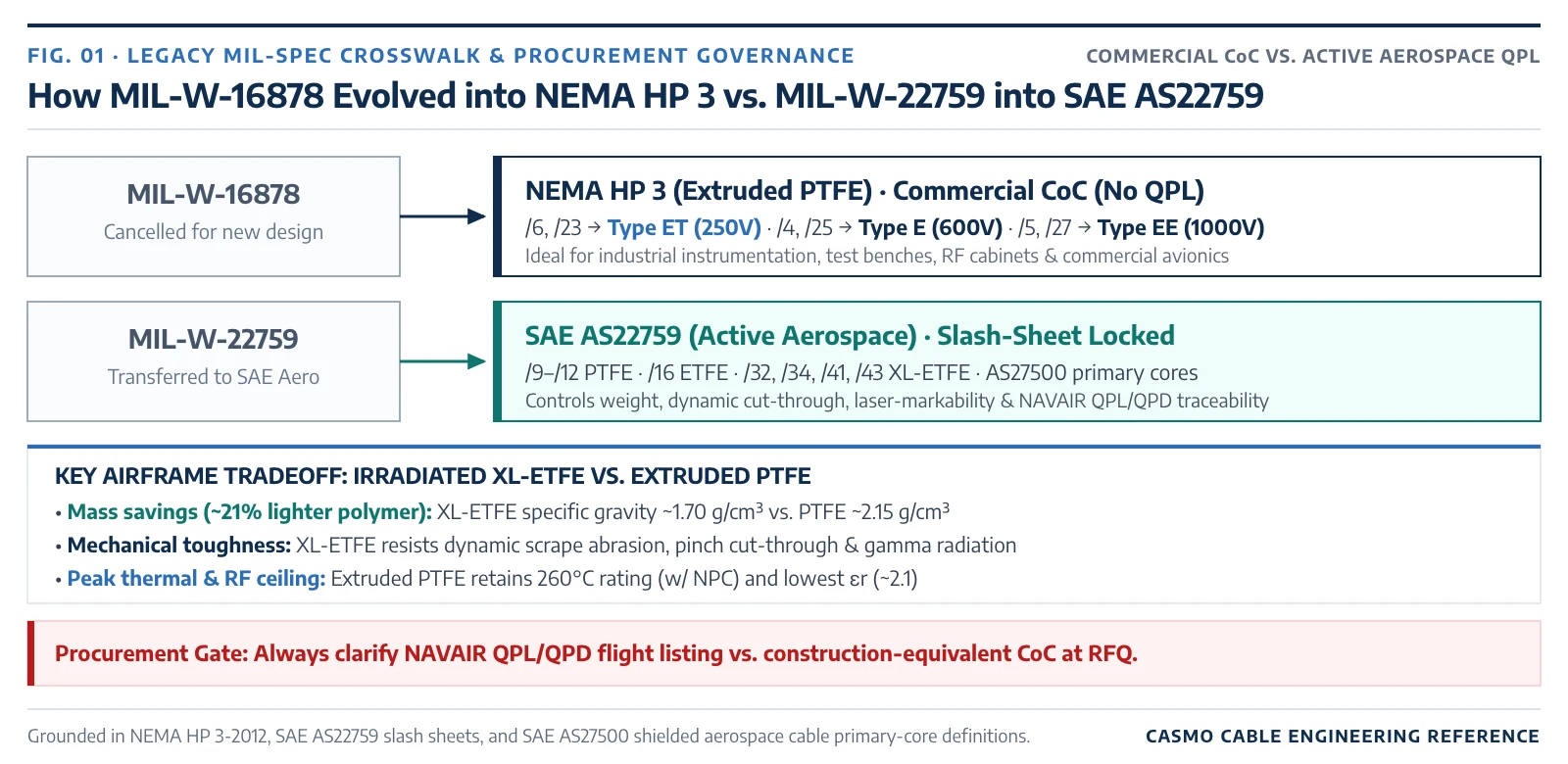
- Legacy M16878/6 (SPC) and M16878/23 (NPC) map to NEMA HP 3 Type ET (250V, thin 6-mil nominal PTFE wall).
- Legacy M16878/4 (SPC) and M16878/25 (NPC) map to NEMA HP 3 Type E (600V, medium 10-mil nominal PTFE wall).
- Legacy M16878/5 (SPC) and M16878/27 (NPC) map to NEMA HP 3 Type EE (1000V, heavy 15-mil nominal PTFE wall).
- Legacy M22759/11, /12, /16, /32, /34, /41, and /43 retain identical slash numbers under SAE AS22759.
Side-by-Side Architecture Comparison: NEMA HP 3 vs. SAE AS22759 Slash Sheets
Wall thickness, voltage class, insulation chemistry, conductor plating, and thermal limits compared
Because every SAE AS22759 slash sheet locks a single insulation polymer, wall weight, conductor plating, and temperature ceiling, engineers must always specify the complete slash designation rather than generic AS22759. The matrix below places the three NEMA HP 3 PTFE types directly beside the most widely deployed SAE AS22759 slash sheets:
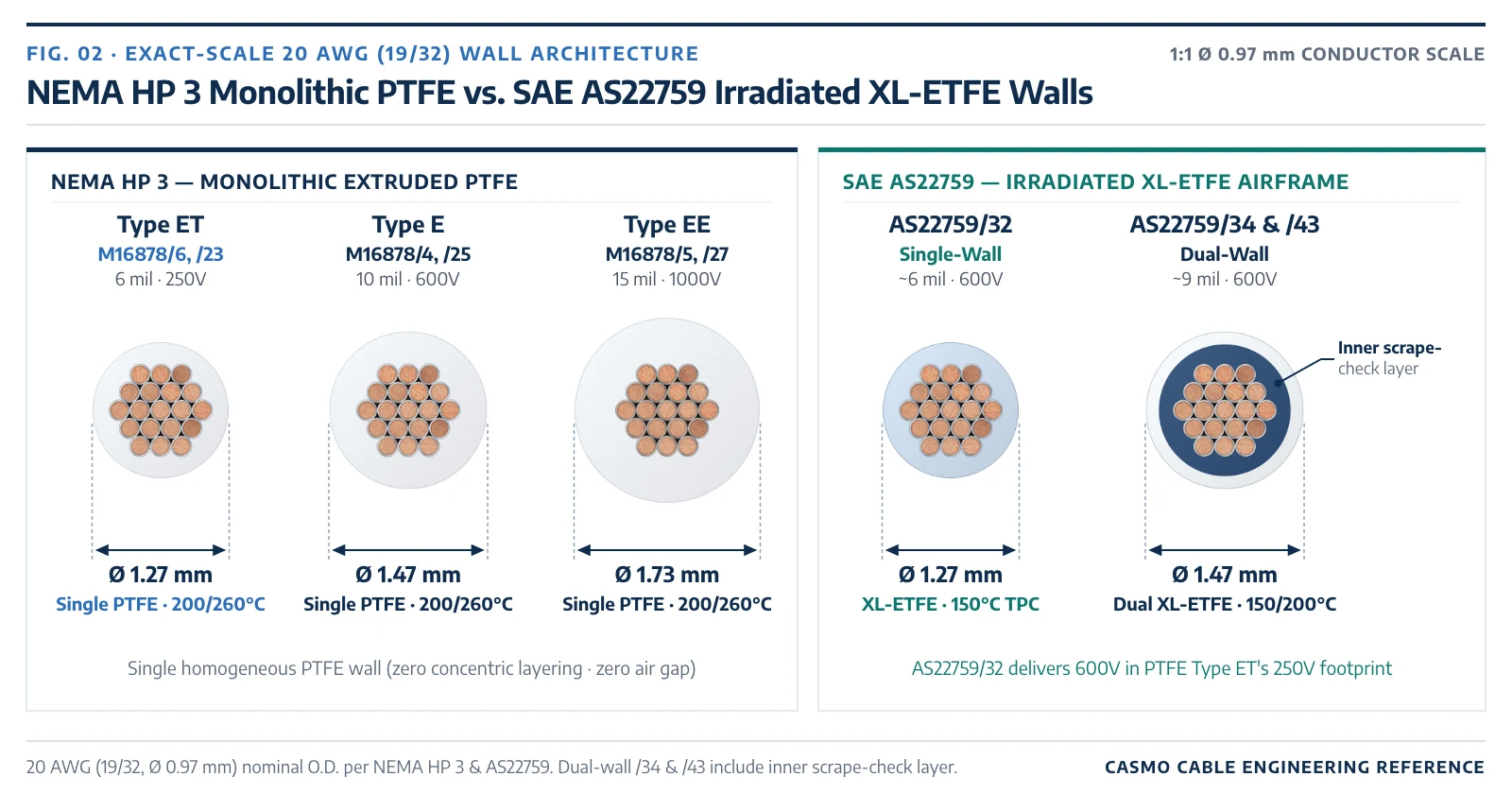
| Designation | Insulation Polymer | Wall Profile / Nominal | Voltage (RMS) | Conductor Plating | Max Continuous Temp |
|---|---|---|---|---|---|
| NEMA HP 3 Type ET (M16878/6, /23) | Extruded PTFE | Thin wall (~6 mil / 0.15 mm) | 250 V | SPC (200°C) or NPC (260°C) | 200°C (SPC) / 260°C (NPC) |
| NEMA HP 3 Type E (M16878/4, /25) | Extruded PTFE | Medium wall (~10 mil / 0.25 mm) | 600 V | SPC (200°C) or NPC (260°C) | 200°C (SPC) / 260°C (NPC) |
| NEMA HP 3 Type EE (M16878/5, /27) | Extruded PTFE | Heavy wall (~15 mil / 0.38 mm) | 1000 V | SPC (200°C) or NPC (260°C) | 200°C (SPC) / 260°C (NPC) |
| SAE AS22759/11 | Extruded PTFE | Medium weight | 600 V | Silver-Plated Copper (SPC) | 200°C |
| SAE AS22759/12 | Extruded PTFE | Medium weight | 600 V | Nickel-Plated Copper (NPC) | 260°C |
| SAE AS22759/9 & /10 | Extruded PTFE | Standard / medium weight | 1000 V | SPC (/9) or NPC (/10) | 200°C (/9) / 260°C (/10) |
| SAE AS22759/16 | Extruded ETFE | Medium / standard weight | 600 V | Tin-Plated Copper (TPC) | 150°C |
| SAE AS22759/32 | Irradiation Cross-Linked XL-ETFE | Lightweight single-wall | 600 V | Tin-Plated Copper (TPC) | 150°C |
| SAE AS22759/34 | Irradiation Cross-Linked XL-ETFE | Normal dual-wall | 600 V | Tin-Plated Copper (TPC) | 150°C |
| SAE AS22759/43 & /41 | Irradiation Cross-Linked XL-ETFE | Normal dual-wall | 600 V | SPC (/43) or NPC (/41) | 200°C |
Conductor Metallurgy & Plating Tradeoffs: Tin vs. Silver vs. Nickel
Balancing conductivity, solderability, red-plague risk, and 260°C thermal oxidation
Across both NEMA HP 3 and SAE AS22759, conductor plating governs not only maximum operating temperature but also termination tooling and long-term corrosion reliability:
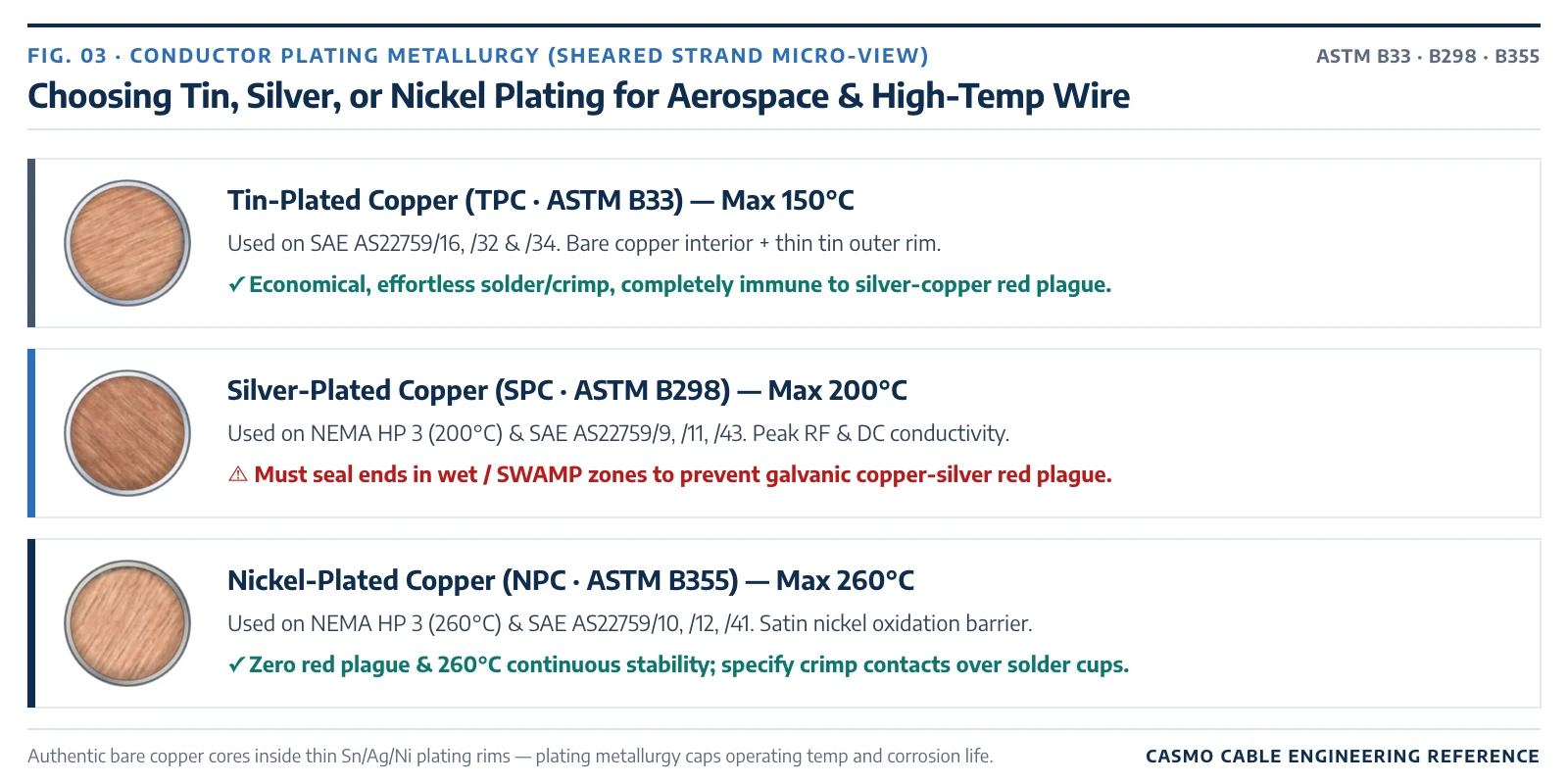
- Tin-Plated Copper (TPC, ASTM B33 — 150°C): Standard on AS22759/16, /32, and /34. Economical, easy to solder and crimp, and completely immune to silver-copper galvanic corrosion, making it the workhorse choice whenever harness zones stay below 150°C.
- Silver-Plated Copper (SPC, ASTM B298 — 200°C): Used on NEMA HP 3 200°C builds and AS22759/9, /11, and /43. Delivers peak RF/DC conductivity and smooth solder wetting. However, if moisture penetrates pinhole-damaged insulation or unsealed crimp joints, silver-copper galvanic attack (red plague) can corrode the underlying copper strands — demanding sealed terminations in humid or marine/SWAMP zones.
- Nickel-Plated Copper (NPC, ASTM B355 — 260°C): Mandatory on NEMA HP 3 260°C builds and AS22759/10, /12, and /41. Nickel forms a passive oxide barrier that resists thermal scaling and chemical attack up to 260°C and eliminates red plague, at the cost of higher contact resistance and poor hand-solderability (high-reliability crimp contacts are strongly preferred over solder cups).
- High-Strength Copper Alloy Conductors: Certain small-gauge aerospace AS22759 slash sheets substitute high-strength copper alloy for annealed copper so 26–22 AWG wires survive dynamic vibration and backshell pull loads without breaking, accepting a modest rise in DC resistance.
Extruded PTFE vs. ETFE & Cross-Linked XL-ETFE in Airframe and Equipment Harnesses
Weight savings, cut-through toughness, radiation resilience, and SAE AS27500 multicore assemblies
When engineers compare NEMA HP 3 Type E against SAE AS22759/11, both use extruded PTFE rated 600V / 200°C over silver-plated copper. The larger engineering fork arrives when deciding between extruded PTFE (/11, /12, NEMA HP 3) and the ETFE / irradiation cross-linked XL-ETFE slash sheets (/16, /32, /34, /41, /43) unique to SAE AS22759.
Extruded PTFE delivers the highest continuous thermal ceiling (260°C with NPC), lowest dielectric constant (~2.1), and broadest chemical inertness. However, PTFE has a higher specific gravity (~2.15 g/cm³ versus ~1.70 g/cm³ for ETFE), is softer against sharp metal edges, and suffers rapid chain-scission degradation under gamma or electron-beam radiation.
Irradiation cross-linked XL-ETFE (such as lightweight single-wall AS22759/32 or normal dual-wall AS22759/34 and /41–/43) solves all three airframe constraints simultaneously: it lowers wire mass per meter, resists dynamic scrape abrasion and cut-through across crowded structural clamps, refuses to melt-flow under transient overload or hot solder contact, and tolerates high radiation doses in space or nuclear environments. For shielded and jacketed multicores, AS22759 single conductors serve as the standardized primary cores inside SAE AS27500 (formerly MIL-C-27500) assemblies, while NEMA HP 3 cores commonly populate commercial NEMA WC 27500 multicores.
Procurement & Qualification Discipline: Construction Compliance vs. QPL Listing
Avoiding specification rejections across commercial aerospace, UAV, defense, and test-rig RFQs
A critical commercial distinction governs how NEMA HP 3 and SAE AS22759 wires are purchased and audited. Because NEMA HP 3 is a voluntary commercial/industrial NEMA standard, it does not maintain a government Qualified Products List (QPL). Manufacturers certify dimensional, spark, thermal, and dielectric conformance through internal laboratory testing and Certificates of Conformance (CoC).
Under SAE AS22759, by contrast, defense and certified flight programs often distinguish strictly between formal NAVAIR QPL/QPD-listed wire (qualified per individual slash sheet, gauge, and manufacturing site under federal oversight) and commercial-equivalent wire manufactured to AS22759 dimensional, material, and electrical specifications (widely used in ground support equipment, industrial UAVs, test benches, radar prototyping, and commercial high-reliability instrumentation).
CASMO manufactures both NEMA HP 3 / HP 4 hook-up wire series and a wide portfolio of SAE AS22759 slash sheets (/9, /10, /11, /12, /16, /32, /34, /41, /43) alongside BS 3G 210 aerospace PTFE wires. Before locking a BOM or purchase order, confirm explicitly whether your end-customer contract requires formal QPL/QPD traceability or construction-compliant wire with full lot test reports.
Frequently Asked Questions
- Is NEMA HP 3 Type E electrically identical to legacy MIL-W-16878/4?
- Yes in core construction and ratings. When MIL-W-16878 was cancelled for new military design, NEMA HP 3 adopted the commercial extruded-PTFE slash sheets directly: Type E (600V, 10 mil nominal PTFE wall) superseded M16878/4 (silver-plated copper, 200°C) and M16878/25 (nickel-plated copper, 260°C).
- What is the main difference between NEMA HP 3 Type E and SAE AS22759/11?
- Both use 600V / 200°C extruded PTFE over silver-plated copper, but NEMA HP 3 Type E is governed as a commercial electronic equipment hook-up standard for enclosed chassis and instrumentation, whereas SAE AS22759/11 is an aerospace airframe wire specification with tighter aerospace dimensional, weight, fluid-immersion, and lot-qualification rules (and serves as a standard core inside SAE AS27500 cables).
- When should I choose AS22759/32 or /34 XL-ETFE instead of PTFE wire?
- Choose radiation cross-linked XL-ETFE (/32 lightweight single-wall or /34 normal dual-wall at 150°C, or /41 and /43 at 200°C) whenever harness weight savings, scrape-abrasion/cut-through strength, and radiation resistance outweigh PTFE's 260°C ceiling or ultra-low RF dielectric loss.
- Why do nickel-plated AS22759/12 and NEMA HP 3 NPC wires reach 260°C while silver-plated versions stop at 200°C?
- Although extruded PTFE insulation handles 260°C continuous heat, silver-plated copper (ASTM B298) oxidizes and diffuses rapidly above 200°C. Nickel plating (ASTM B355) provides a high-temperature oxidation barrier enabling continuous 260°C service while also preventing galvanic red-plague corrosion.
- Does buying wire built to SAE AS22759 automatically include NAVAIR QPL approval?
- No. Formal NAVAIR QPL/QPD qualification is granted strictly per manufacturer plant, individual slash sheet, and AWG gauge. Always state in your RFQ whether formal QPL/QPD documentation is contractually required or whether commercial-equivalent wire manufactured to AS22759 specifications is acceptable.
- What is the difference between NEMA HP 3 and NEMA HP 4?
- NEMA HP 3 specifies paste-extruded PTFE insulation (Types ET, E, and EE rated 200°C with SPC or 260°C with NPC), whereas NEMA HP 4 specifies melt-extruded FEP insulation (Types KT, K, and KK rated up to 200°C) for longer continuous splice-free spool lengths and smoother flexibility.
Regulatory & Engineering References
- NEMA — NEMA HP 3-2012 (Electrical and Electronic PTFE Insulated High Temperature Hook-Up Wire) and NEMA HP 4-2012 (FEP Insulated High Temperature Hook-Up Wire).
- SAE International — SAE AS22759 (Wire, Electrical, Fluoropolymer-Insulated, Copper or Copper Alloy) and slash sheets /9, /10, /11, /12, /16, /32, /34, /41, and /43.
- SAE International — SAE AS27500 (Standard for Aerospace and Industrial Electrical Cable) and NEMA WC 27500 shielded/jacketed multicore cable specifications.
- ASTM International — ASTM B33 (Tin-Coated Copper), ASTM B298 (Silver-Coated Copper), and ASTM B355 (Nickel-Coated Copper) conductor plating standards.
- NASA / Aerospace Wire Selection Handbooks — Comparative evaluations of PTFE, ETFE, and cross-linked XL-ETFE airframe wires and red-plague mitigation practices.